

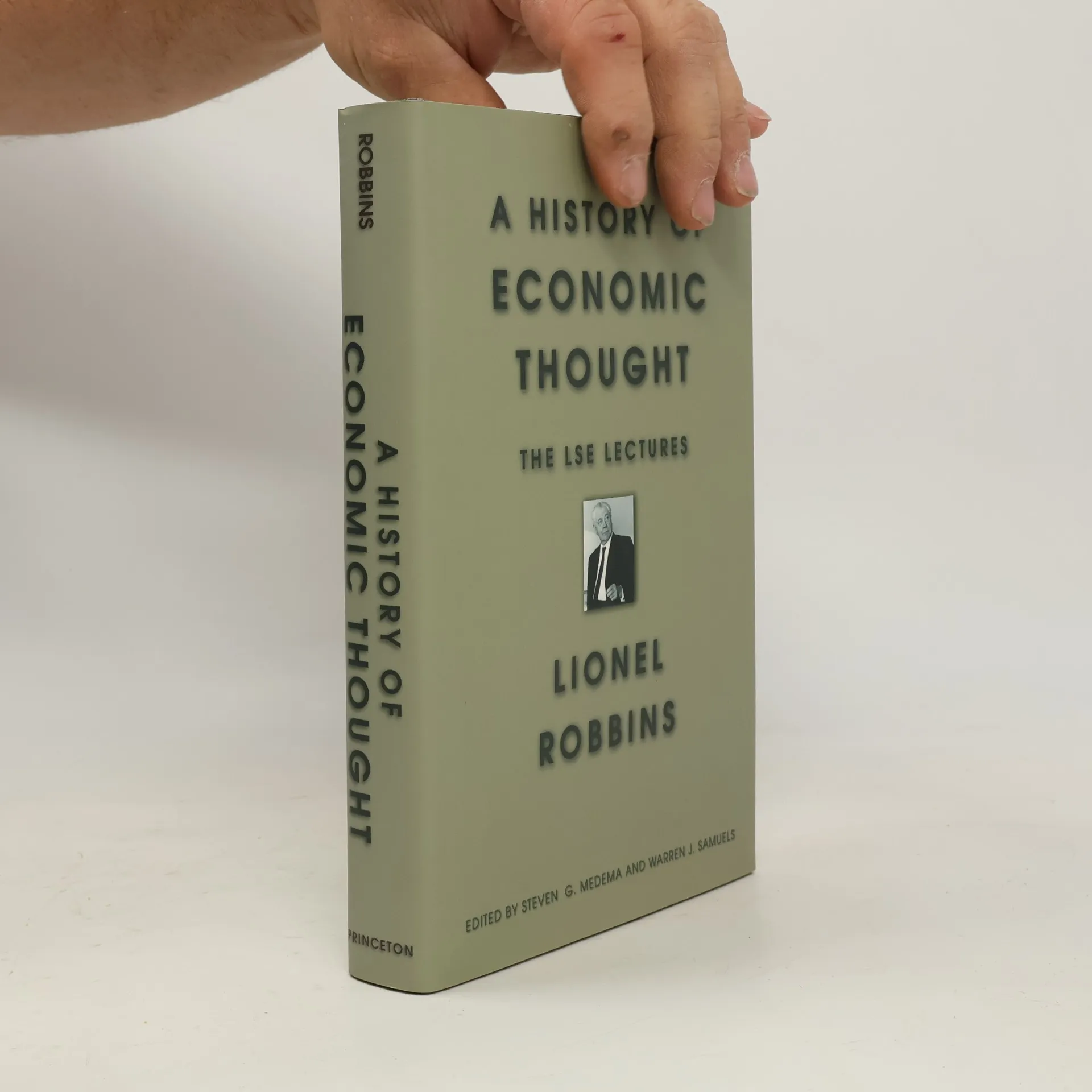
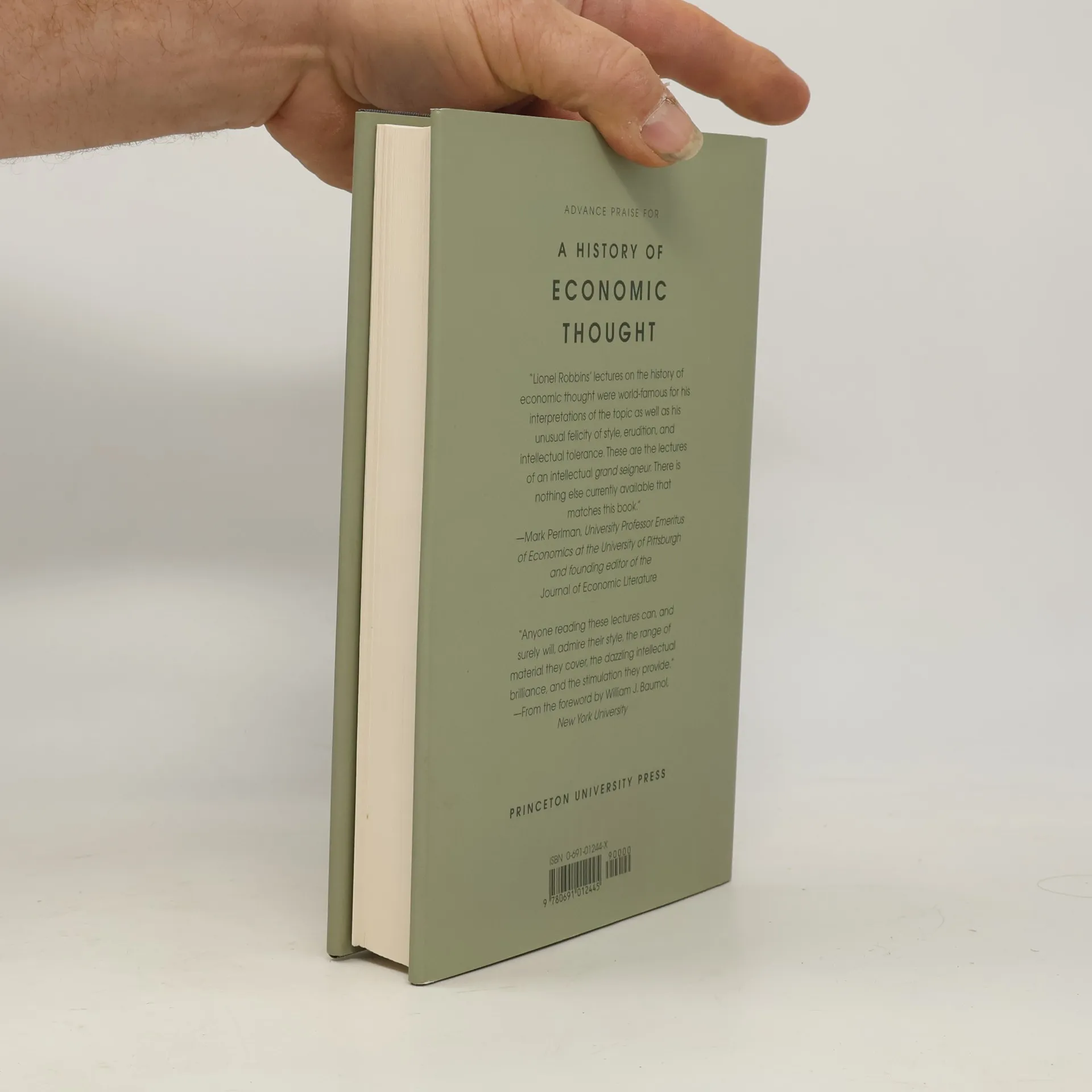

A History of Economic Thought
Más información sobre el libro
Lionel Robbins's now famous lectures on the history of economic thought comprise one of the greatest accounts since World War II of the evolution of economic ideas. This volume represents the first time those lectures have been published. Lord Robbins (1898-1984) was a remarkably accomplished thinker, writer, and public figure. He made important contributions to economic theory, methodology, and policy analysis, directed the economic section of Winston Churchill's War Cabinet, and served as chairman of the <i>Financial Times</i>. As a historian of economic ideas, he ranks with Joseph Schumpeter and Jacob Viner as one of the foremost scholars of the century. These lectures, delivered at the London School of Economics between 1979 and 1981 and tape-recorded by Robbins's grandson, display his mastery of the intellectual history of economics, his infectious enthusiasm for the subject, and his eloquence and incisive wit. They cover a broad chronological range, beginning with Plato, Aristotle, and Aquinas, focusing extensively on Adam Smith, Thomas Malthus and the classicals, and finishing with a discussion of moderns and marginalists from Marx to Alfred Marshall. Robbins takes a varied and inclusive approach to intellectual history. As he says in his first lecture: I shall go my own sweet way--sometimes talk about doctrine, sometimes talk about persons, sometimes talk about periods. The lectures are united by Robbins's conviction that it is impossible to understand adequately contemporary institutions and social sciences without understanding the ideas behind their development. Authoritative yet accessible, combining the immediacy of the spoken word with Robbins's exceptional talent for clear, well-organized exposition, this volume will be welcomed by anyone interested in the intellectual origins of the modern world.
Compra de libros
A History of Economic Thought, Lionel Robbins, William J. Baumol, Warren J. Samuels, London School of Economics and Political Science, Steven G. Medema
- Idioma

- Publicado en
- 1998
- Encuadernación
- (Tapa dura),
- Estado del libro
- Bueno
- Precio
- 29,99 €
Métodos de pago
Nadie lo ha calificado todavía.
- Título
- A History of Economic Thought
- Idioma
- Inglés
- Autores
- Lionel Robbins, William J. Baumol, Warren J. Samuels, London School of Economics and Political Science, Steven G. Medema
- Editorial
- Princeton University Press
- Publicado en
- 1998
- Formato
- Tapa dura
- Páginas
- 359
- ISBN10
- 069101244X
- ISBN13
- 9780691012445
- Serie
- Categorías
- Etiquetas
- EE.UU., Teorías científicas, Historia social
- Descripción
- Lionel Robbins's now famous lectures on the history of economic thought comprise one of the greatest accounts since World War II of the evolution of economic ideas. This volume represents the first time those lectures have been published. Lord Robbins (1898-1984) was a remarkably accomplished thinker, writer, and public figure. He made important contributions to economic theory, methodology, and policy analysis, directed the economic section of Winston Churchill's War Cabinet, and served as chairman of the <i>Financial Times</i>. As a historian of economic ideas, he ranks with Joseph Schumpeter and Jacob Viner as one of the foremost scholars of the century. These lectures, delivered at the London School of Economics between 1979 and 1981 and tape-recorded by Robbins's grandson, display his mastery of the intellectual history of economics, his infectious enthusiasm for the subject, and his eloquence and incisive wit. They cover a broad chronological range, beginning with Plato, Aristotle, and Aquinas, focusing extensively on Adam Smith, Thomas Malthus and the classicals, and finishing with a discussion of moderns and marginalists from Marx to Alfred Marshall. Robbins takes a varied and inclusive approach to intellectual history. As he says in his first lecture: I shall go my own sweet way--sometimes talk about doctrine, sometimes talk about persons, sometimes talk about periods. The lectures are united by Robbins's conviction that it is impossible to understand adequately contemporary institutions and social sciences without understanding the ideas behind their development. Authoritative yet accessible, combining the immediacy of the spoken word with Robbins's exceptional talent for clear, well-organized exposition, this volume will be welcomed by anyone interested in the intellectual origins of the modern world.