



Más información sobre el libro
Early Greek Thought calls into question a longstanding mythology - operative in both the Analytic and Continental traditions - that the 'Pre-Socratics had the grandiose audacity to break with all traditional forms of knowledge' (Badiou). Each of the variants of this mythology is dismantled in an attempt to not only retrieve an 'indigenous' interpretation of early Greek thought, but also to expose the mythological character of our own contemporary meta-narratives regarding the 'origins' of 'Western', 'Occidental' philosophy. Using an original hermeneutical approach, James Luchte excavates the context of emergence of early Greek thought through an exploration of the mytho-poetic horizons of the archaic world, in relation to which, as Plato testifies, the Greeks were merely 'children'. Luchte discloses 'philosophy in the tragic age' as a creative response to a 'contestation' of mytho-poetic narratives and 'ways of being'. The tragic character of early Greek thought is unfolded through a cultivation of a conversation between its basic thinkers, one which would remain incomprehensible, with Bataille, in the 'absence of myth' and the exile of poetry.
Compra de libros
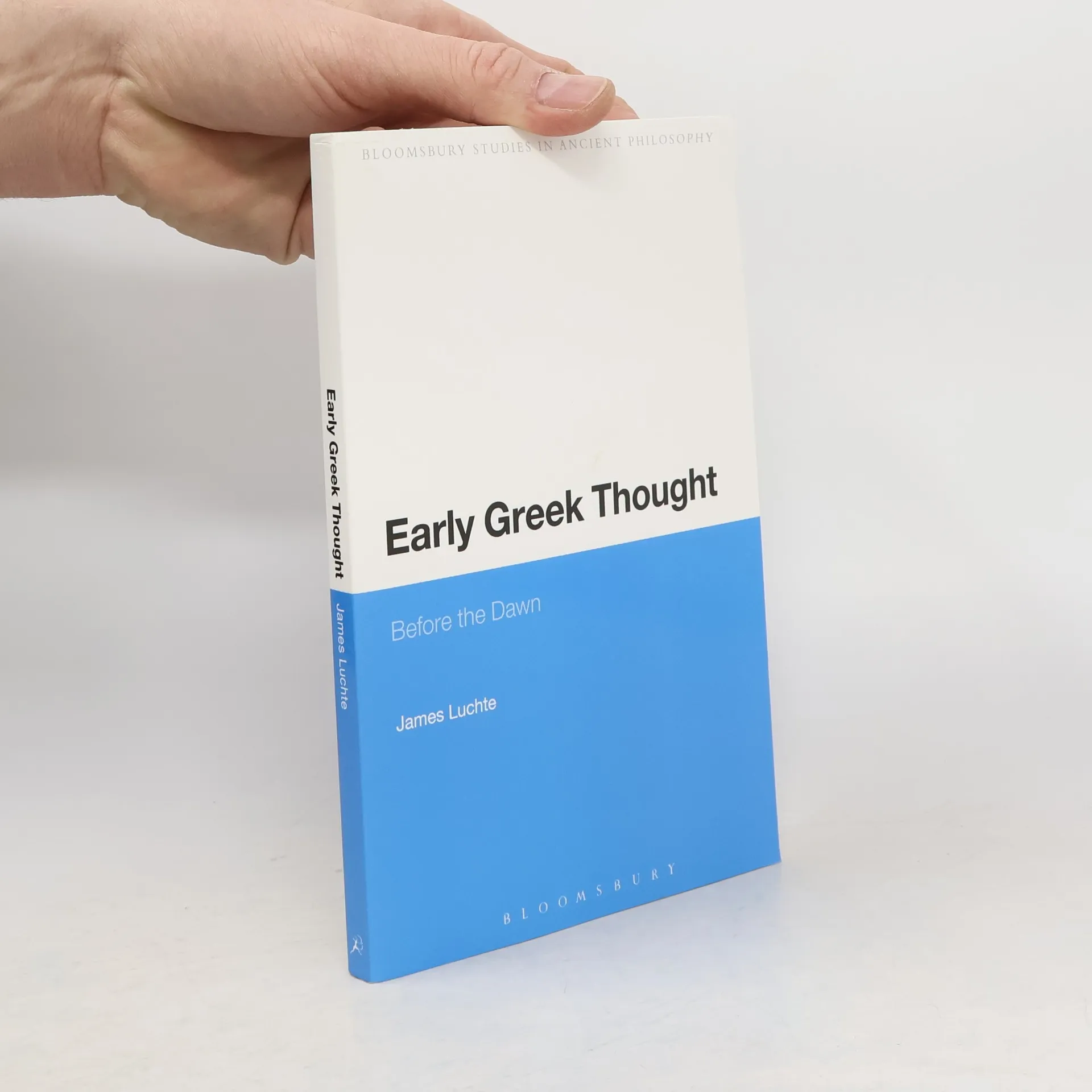
Bloomsbury Studies in Ancient Philosophy: Early Greek Thought, James Luchte
- Idioma

- Publicado en
- 2013
- Encuadernación
- (Tapa blanda)
Métodos de pago
Nadie lo ha calificado todavía.
- Título
- Bloomsbury Studies in Ancient Philosophy: Early Greek Thought
- Subtítulo
- Before the Dawn
- Idioma
- Inglés
- Autores
- James Luchte
- Editorial
- Bloomsbury Academic
- Publicado en
- 2013
- Formato
- Tapa blanda
- Páginas
- 224
- ISBN10
- 0567353311
- ISBN13
- 9780567353313
- Serie
- Categorías
- Etiquetas
- Temática filosófica, Antigüedad, Grecia, Imperio Romano, Grecia antigua, Filosofía Antigua y Clásica, Filosofía Griega
- Descripción
- Early Greek Thought calls into question a longstanding mythology - operative in both the Analytic and Continental traditions - that the 'Pre-Socratics had the grandiose audacity to break with all traditional forms of knowledge' (Badiou). Each of the variants of this mythology is dismantled in an attempt to not only retrieve an 'indigenous' interpretation of early Greek thought, but also to expose the mythological character of our own contemporary meta-narratives regarding the 'origins' of 'Western', 'Occidental' philosophy. Using an original hermeneutical approach, James Luchte excavates the context of emergence of early Greek thought through an exploration of the mytho-poetic horizons of the archaic world, in relation to which, as Plato testifies, the Greeks were merely 'children'. Luchte discloses 'philosophy in the tragic age' as a creative response to a 'contestation' of mytho-poetic narratives and 'ways of being'. The tragic character of early Greek thought is unfolded through a cultivation of a conversation between its basic thinkers, one which would remain incomprehensible, with Bataille, in the 'absence of myth' and the exile of poetry.