

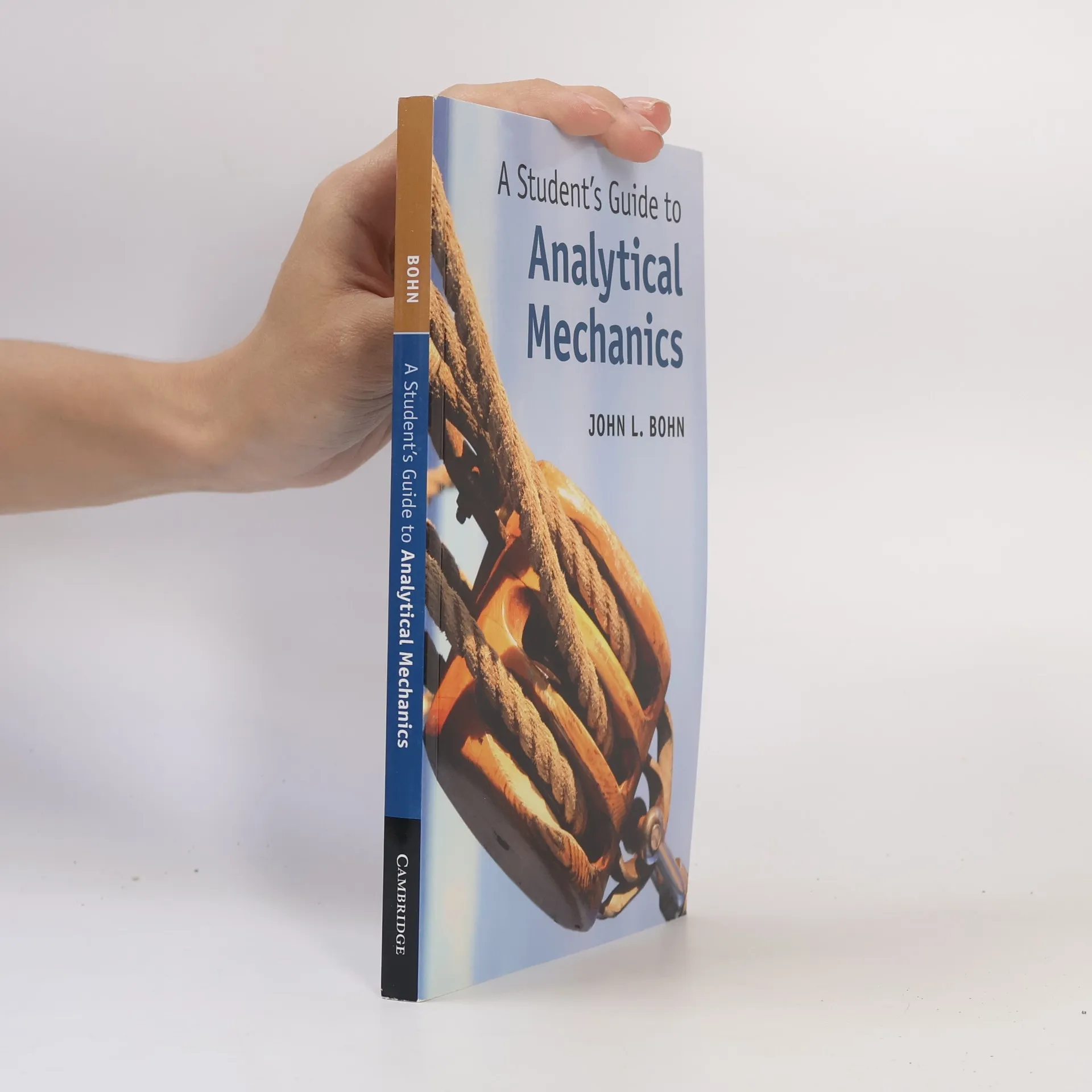


Más información sobre el libro
Analytical mechanics is a set of mathematical tools used to describe a wide range of physical systems, both in classical mechanics and beyond. It offers a powerful and elegant alternative to Newtonian mechanics; however it can be challenging to learn due to its high degree of mathematical complexity. Designed to offer a more intuitive guide to this abstract topic, this guide explains the mathematical theory underlying analytical mechanics; helping students to formulate, solve and interpret complex problems using these analytical tools. Each chapter begins with an example of a physical system to illustrate the theoretical steps to be developed in that chapter, and ends with a set of exercises to further develop students' understanding. The book presents the fundamentals of the subject in depth before extending the theory to more elaborate systems, and includes a further reading section to ensure that this is an accessible companion to all standard textbooks.
Compra de libros
A Student's Guide to Analytical Mechanics, John L Bohn
- Idioma

- Publicado en
- 2018
- Encuadernación
- (Tapa blanda)
Métodos de pago
Nadie lo ha calificado todavía.
- Título
- A Student's Guide to Analytical Mechanics
- Idioma
- Inglés
- Autores
- John L Bohn
- Editorial
- Cambridge University Press
- Publicado en
- 2018
- Formato
- Tapa blanda
- Páginas
- 218
- ISBN10
- 1316509079
- ISBN13
- 9781316509074
- Serie
- Categorías
- Etiquetas
- Descripción
- Analytical mechanics is a set of mathematical tools used to describe a wide range of physical systems, both in classical mechanics and beyond. It offers a powerful and elegant alternative to Newtonian mechanics; however it can be challenging to learn due to its high degree of mathematical complexity. Designed to offer a more intuitive guide to this abstract topic, this guide explains the mathematical theory underlying analytical mechanics; helping students to formulate, solve and interpret complex problems using these analytical tools. Each chapter begins with an example of a physical system to illustrate the theoretical steps to be developed in that chapter, and ends with a set of exercises to further develop students' understanding. The book presents the fundamentals of the subject in depth before extending the theory to more elaborate systems, and includes a further reading section to ensure that this is an accessible companion to all standard textbooks.