



Más información sobre el libro
Since the publication of Ernst Badian's groundbreaking study „Foreign Clientelae“ in 1958, his emphasis on the personal relations between Roman senators and members of the provincial elites has become the dominant interpretation for studies of the Roman Empire. Accordingly, Rome not only conceptualized her relations with communities all over the Mediterranean in the form and language of patronage (amicitia, patronus, cliens) but also heavily relied upon them in order to control the Empire. Moreover, it is assumed that these relationships enhanced the position and influence of Roman nobles back home. In this volume, 18 authors from 6 countries reexamine some underlying theoretical assumptions of this paradigma as well as its actual application by means of different case-studies. As a result, it becomes clear that the usual methods for identifying foreign clientelae by identic names cannot be sustained and the importance of the phenomenon both for the Romans and for the Empire seems to be overestimated. The volume thus offers a fresh approach for analysing „Foreign Clientelae“ while at the same time assessing its significance more appropriately.
Compra de libros
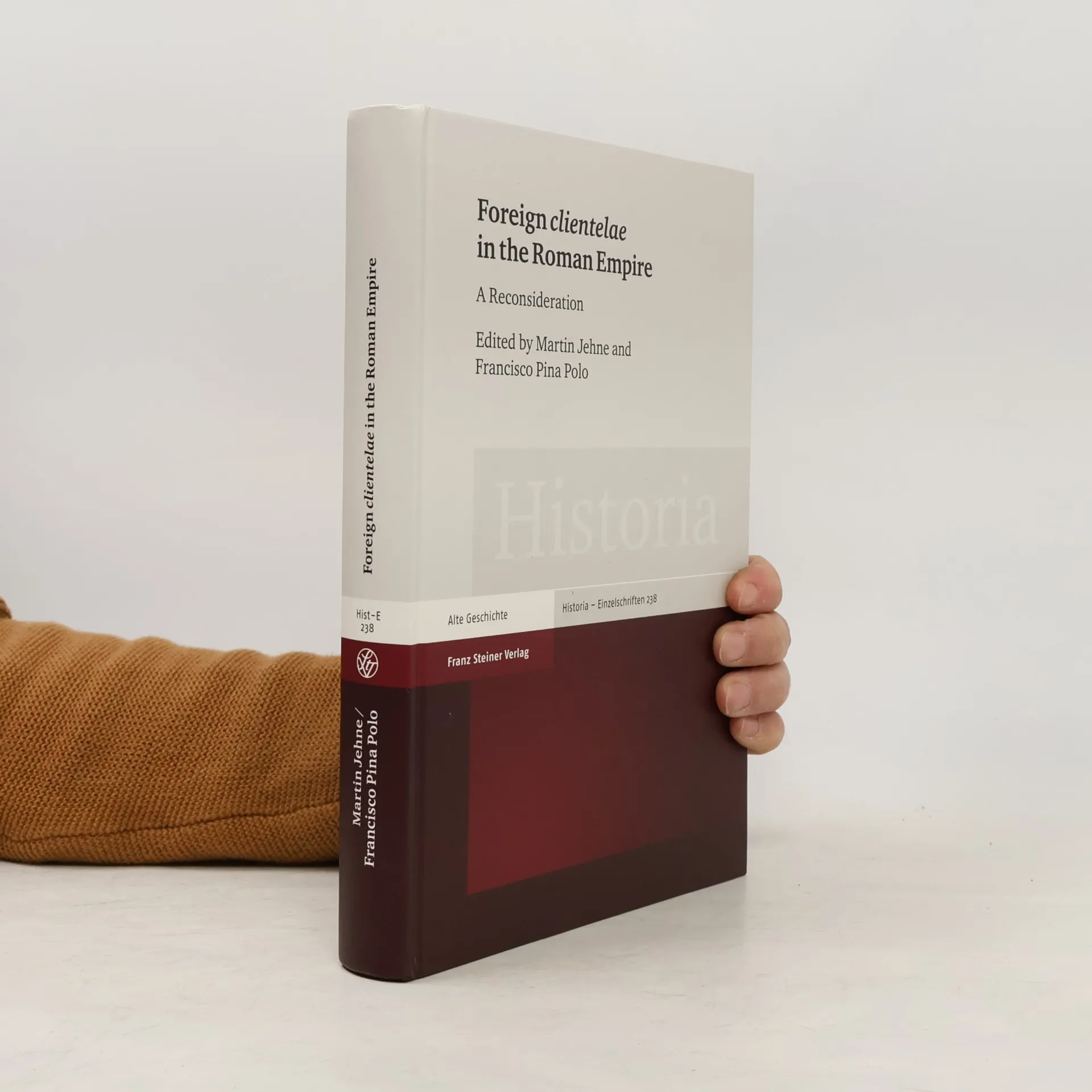
Historia - Einzelschriften - 238: Foreign "Clientelae" in the Roman Empire, Martin Jehne, Francisco Pina Polo
- Idioma

- Publicado en
- 2015
- Encuadernación
- (Tapa dura),
- Estado del libro
- Muy Bueno
- Precio
- 66,39 €
Métodos de pago
Nadie lo ha calificado todavía.
- Título
- Historia - Einzelschriften - 238: Foreign "Clientelae" in the Roman Empire
- Subtítulo
- A Reconsideration
- Idioma
- Inglés
- Autores
- Martin Jehne, Francisco Pina Polo
- Editorial
- Franz Steiner Verlag
- Publicado en
- 2015
- Formato
- Tapa dura
- Páginas
- 374
- ISBN10
- 3515110615
- ISBN13
- 9783515110617
- Serie
- Etiquetas
- Tema histórico, Antigüedad, Roma, Imperio Romano
- Descripción
- Since the publication of Ernst Badian's groundbreaking study „Foreign Clientelae“ in 1958, his emphasis on the personal relations between Roman senators and members of the provincial elites has become the dominant interpretation for studies of the Roman Empire. Accordingly, Rome not only conceptualized her relations with communities all over the Mediterranean in the form and language of patronage (amicitia, patronus, cliens) but also heavily relied upon them in order to control the Empire. Moreover, it is assumed that these relationships enhanced the position and influence of Roman nobles back home. In this volume, 18 authors from 6 countries reexamine some underlying theoretical assumptions of this paradigma as well as its actual application by means of different case-studies. As a result, it becomes clear that the usual methods for identifying foreign clientelae by identic names cannot be sustained and the importance of the phenomenon both for the Romans and for the Empire seems to be overestimated. The volume thus offers a fresh approach for analysing „Foreign Clientelae“ while at the same time assessing its significance more appropriately.