

Más información sobre el libro
The smooth functioning of an ordered society depends on the possession of a means of regularising its activities over time. That means is a calendar, and its regularity is a function of how well it models the more or less regular movements of the celestial bodies - of the moon, the sun or the stars. Greek and Roman Calendars examines the ancient calendar as just such a time-piece, whose elements are readily described in astronomical and mathematical terms. The story of these calendars is one of a continuous struggle to maintain a correspondence with the regularity of the seasons and the sun, despite the fact that the calendars were usually based on the irregular moon. But on another, more human level, Greek and Roman Calendars steps beyond the merely mathematical and studies the calendar as a social instrument, which people used to organise their activities. It sets the calendars of the Greeks and Romans on a stage occupied by real people, who developed and lived with these time-pieces for a variety of purposes - agricultural, religious, political and economic.This is also a story of intersecting cultures, of Greeks with Greeks, of Greeks with Persians and Egyptians, and of Greeks with Romans, in which various calendaric traditions clashed or compromised.
Compra de libros
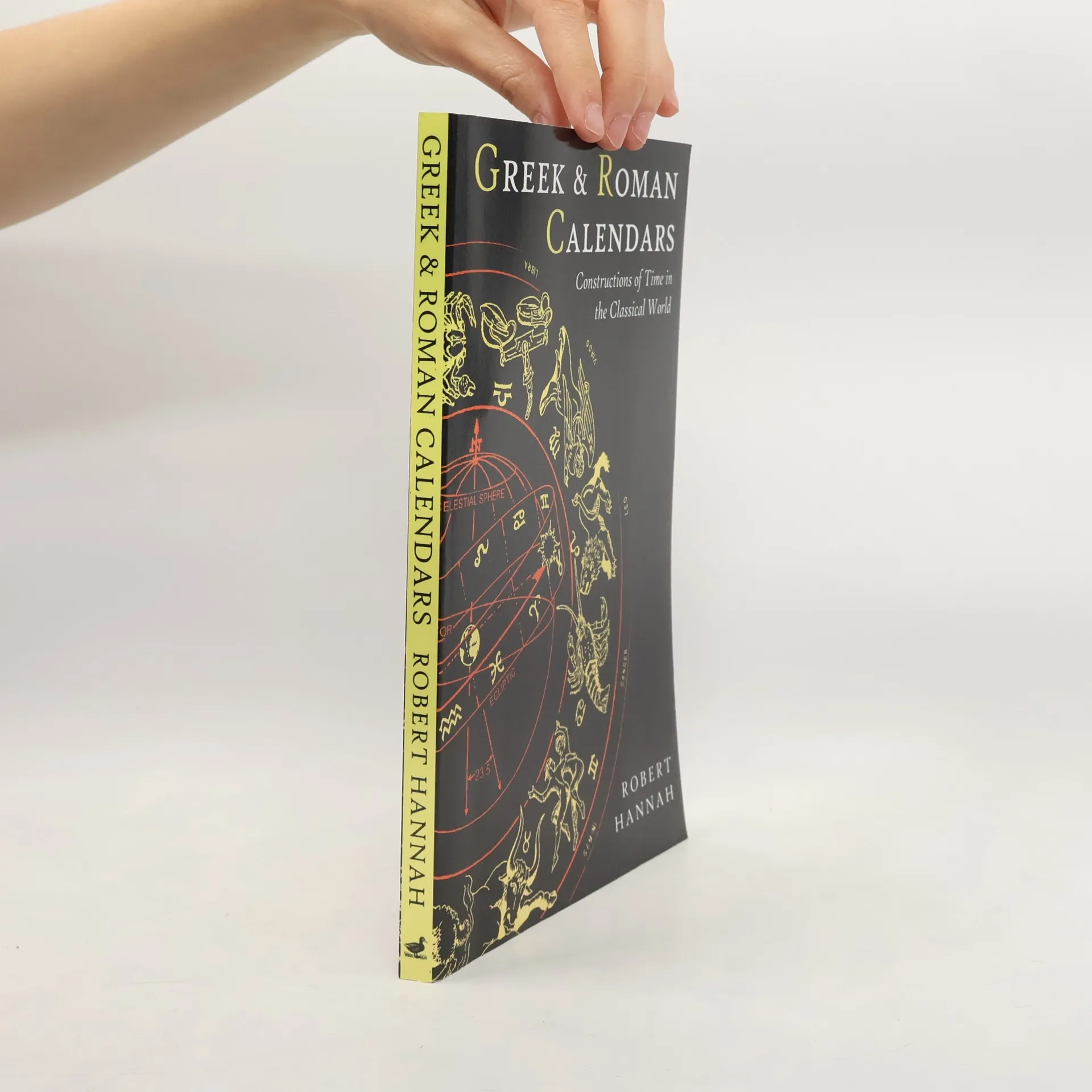
Greek and Roman Calendars, Robert Hannah
- Idioma

- Publicado en
- 2005
- Encuadernación
- (Tapa blanda)
Métodos de pago
Nadie lo ha calificado todavía.
- Título
- Greek and Roman Calendars
- Subtítulo
- Constructions of Time in the Classical World
- Idioma
- Inglés
- Autores
- Robert Hannah
- Editorial
- Bristol Classical Press
- Publicado en
- 2005
- Formato
- Tapa blanda
- Páginas
- 170
- ISBN10
- 0715633015
- ISBN13
- 9780715633014
- Serie
- Etiquetas
- Tema histórico, Ciencia, Espacio, Antigüedad, Crítica literaria, Europa Occidental, Calendarios, Tiempo
- Descripción
- The smooth functioning of an ordered society depends on the possession of a means of regularising its activities over time. That means is a calendar, and its regularity is a function of how well it models the more or less regular movements of the celestial bodies - of the moon, the sun or the stars. Greek and Roman Calendars examines the ancient calendar as just such a time-piece, whose elements are readily described in astronomical and mathematical terms. The story of these calendars is one of a continuous struggle to maintain a correspondence with the regularity of the seasons and the sun, despite the fact that the calendars were usually based on the irregular moon. But on another, more human level, Greek and Roman Calendars steps beyond the merely mathematical and studies the calendar as a social instrument, which people used to organise their activities. It sets the calendars of the Greeks and Romans on a stage occupied by real people, who developed and lived with these time-pieces for a variety of purposes - agricultural, religious, political and economic.This is also a story of intersecting cultures, of Greeks with Greeks, of Greeks with Persians and Egyptians, and of Greeks with Romans, in which various calendaric traditions clashed or compromised.