




Más información sobre el libro
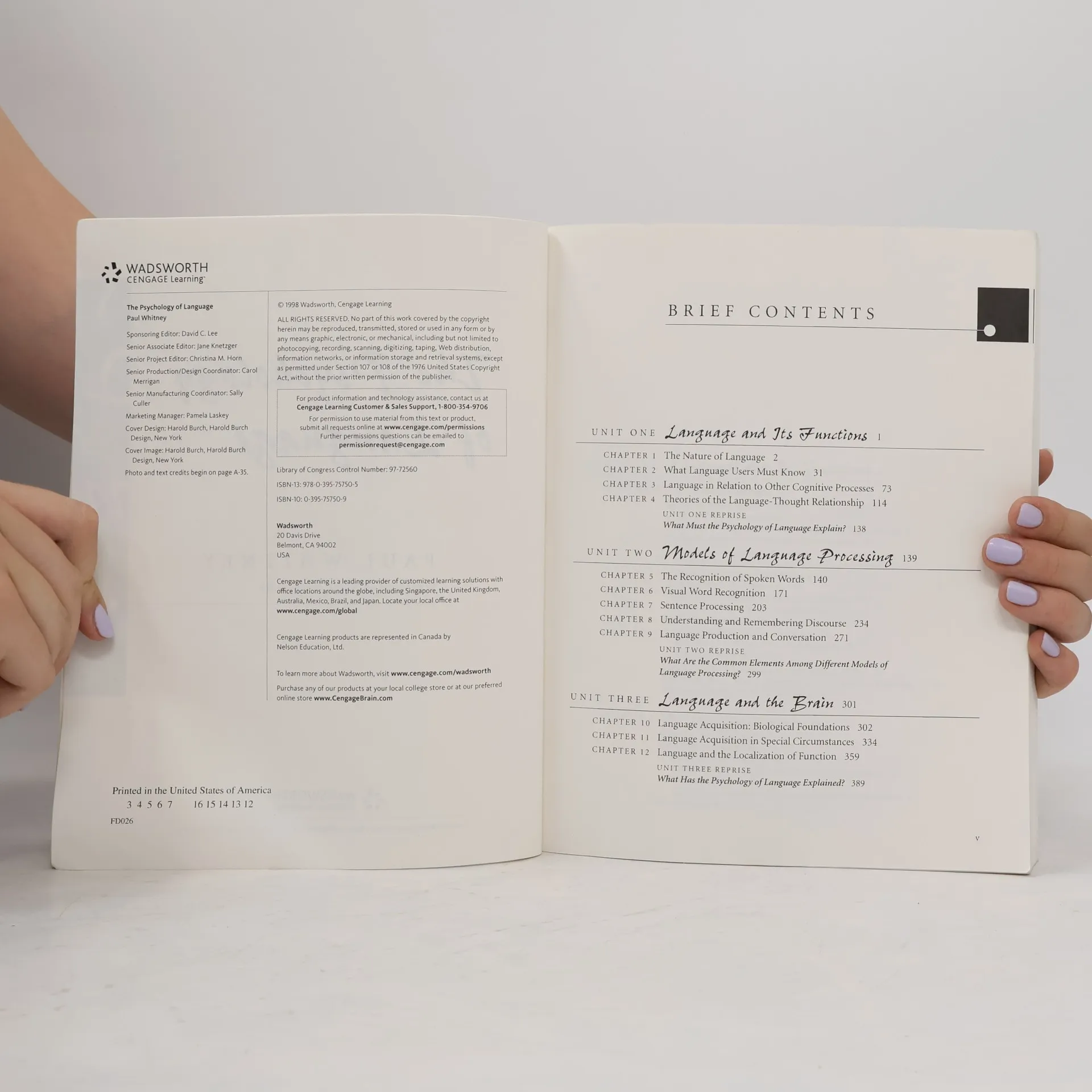
Written in a lively, accessible style, this text explores the relationship between language and human cognition. Each chapter presents a central theme as a hypothesis for students to consider, organized into three parts: Linguistics, Cognition, and Neuroscience, mirroring Marr's levels of analysis. Unit 1 delves into language and its functions, discussing the nature and origins of language, comparing human and nonhuman communication, and addressing linguistic knowledge necessary for users. It also examines the interplay between language and cognitive processes, historical perspectives, and theories on the language-thought relationship, including the Sapir-Whorf Hypothesis. Unit 2 focuses on models of language processing, covering spoken and visual word recognition, sentence processing, and discourse comprehension. It investigates how we study these processes, the nature of speech signals, and the factors influencing recognition, leading to insights about language production and its social context. Unit 3 addresses language and the brain, discussing language acquisition milestones, the impact of atypical environments, and the localization of language functions. It reviews aphasia studies and modern methods for understanding how language processes are organized in the brain, culminating in a discussion of what the psychology of language has explained.
Compra de libros
The Psychology of Language, Paul Whitney
- Idioma

- Publicado en
- 2012
- Encuadernación
- (Tapa blanda)
Métodos de pago
Nadie lo ha calificado todavía.
- Título
- The Psychology of Language
- Idioma
- Inglés
- Autores
- Paul Whitney
- Editorial
- Houghton Mifflin
- Publicado en
- 2012
- Formato
- Tapa blanda
- Páginas
- 390
- ISBN10
- 0395757509
- ISBN13
- 9780395757505
- Serie
- Categorías
- Etiquetas
- Temas psicológicos, Lingüística, Psicolingüística
- Descripción
- Written in a lively, accessible style, this text explores the relationship between language and human cognition. Each chapter presents a central theme as a hypothesis for students to consider, organized into three parts: Linguistics, Cognition, and Neuroscience, mirroring Marr's levels of analysis. Unit 1 delves into language and its functions, discussing the nature and origins of language, comparing human and nonhuman communication, and addressing linguistic knowledge necessary for users. It also examines the interplay between language and cognitive processes, historical perspectives, and theories on the language-thought relationship, including the Sapir-Whorf Hypothesis. Unit 2 focuses on models of language processing, covering spoken and visual word recognition, sentence processing, and discourse comprehension. It investigates how we study these processes, the nature of speech signals, and the factors influencing recognition, leading to insights about language production and its social context. Unit 3 addresses language and the brain, discussing language acquisition milestones, the impact of atypical environments, and the localization of language functions. It reviews aphasia studies and modern methods for understanding how language processes are organized in the brain, culminating in a discussion of what the psychology of language has explained.