


Más información sobre el libro
This book challenges and intrigues from beginning to end, making it ideal for a capstone course or senior seminar. Solitons, nonlinear waves that behave like interacting particles, were initially dismissed by leading mathematical physicists in the 19th century. Today, they are observed in nature, illuminating phenomena such as rogue waves and DNA transcription. Engineers utilize solitons of light for data transmission and optical switches. Unlike most nonlinear partial differential equations, soliton equations are exactly solvable, offering explicit solutions that reveal the possibilities within nonlinearity. The text explores the connections uncovered over the last fifty years that elucidate these mathematical objects, presenting the algebro-geometric structure of soliton equations as a sophisticated explanation for their existence. The book introduces the KdV Equation and its multisoliton solutions, elliptic curves, differential operators, Lax Pairs, the KP Hierarchy, and Sato's theory linking the Bilinear KP Equation to Grassmannian geometry, all while assuming a background in multivariable calculus and linear algebra. Notable features include a careful selection of topics, detailed explanations, numerous examples, thought-provoking exercises, and the use of Mathematica® for computation. The second edition refines the exposition, adds homework exercises, updates references, and expands the chapter on KdV multisolitons with
Compra de libros
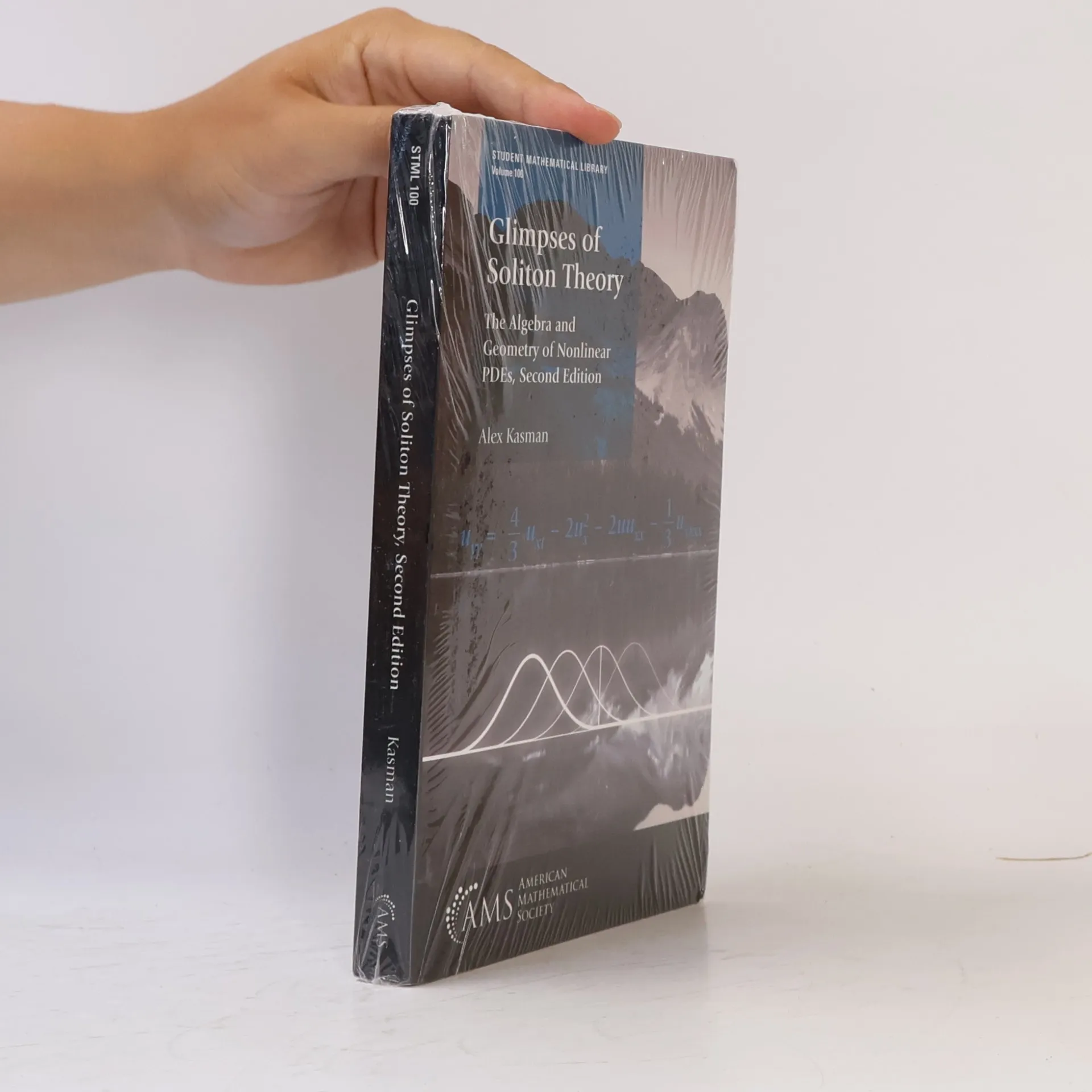
Student Mathematical Library - 100: Glimpses of Soliton Theory, Alex Kasman
- Idioma

- Publicado en
- 2023
- Encuadernación
- (Tapa blanda),
- Estado del libro
- Muy Bueno
- Precio
- 22,69 €
Métodos de pago
Nadie lo ha calificado todavía.
- Título
- Student Mathematical Library - 100: Glimpses of Soliton Theory
- Subtítulo
- The Algebra and Geometry of Nonlinear PDEs, Second Edition
- Idioma
- Inglés
- Autores
- Alex Kasman
- Editorial
- American Mathematical Society
- Publicado en
- 2023
- Formato
- Tapa blanda
- Páginas
- 347
- ISBN10
- 1470472627
- ISBN13
- 9781470472627
- Serie
- Descripción
- This book challenges and intrigues from beginning to end, making it ideal for a capstone course or senior seminar. Solitons, nonlinear waves that behave like interacting particles, were initially dismissed by leading mathematical physicists in the 19th century. Today, they are observed in nature, illuminating phenomena such as rogue waves and DNA transcription. Engineers utilize solitons of light for data transmission and optical switches. Unlike most nonlinear partial differential equations, soliton equations are exactly solvable, offering explicit solutions that reveal the possibilities within nonlinearity. The text explores the connections uncovered over the last fifty years that elucidate these mathematical objects, presenting the algebro-geometric structure of soliton equations as a sophisticated explanation for their existence. The book introduces the KdV Equation and its multisoliton solutions, elliptic curves, differential operators, Lax Pairs, the KP Hierarchy, and Sato's theory linking the Bilinear KP Equation to Grassmannian geometry, all while assuming a background in multivariable calculus and linear algebra. Notable features include a careful selection of topics, detailed explanations, numerous examples, thought-provoking exercises, and the use of Mathematica® for computation. The second edition refines the exposition, adds homework exercises, updates references, and expands the chapter on KdV multisolitons with