

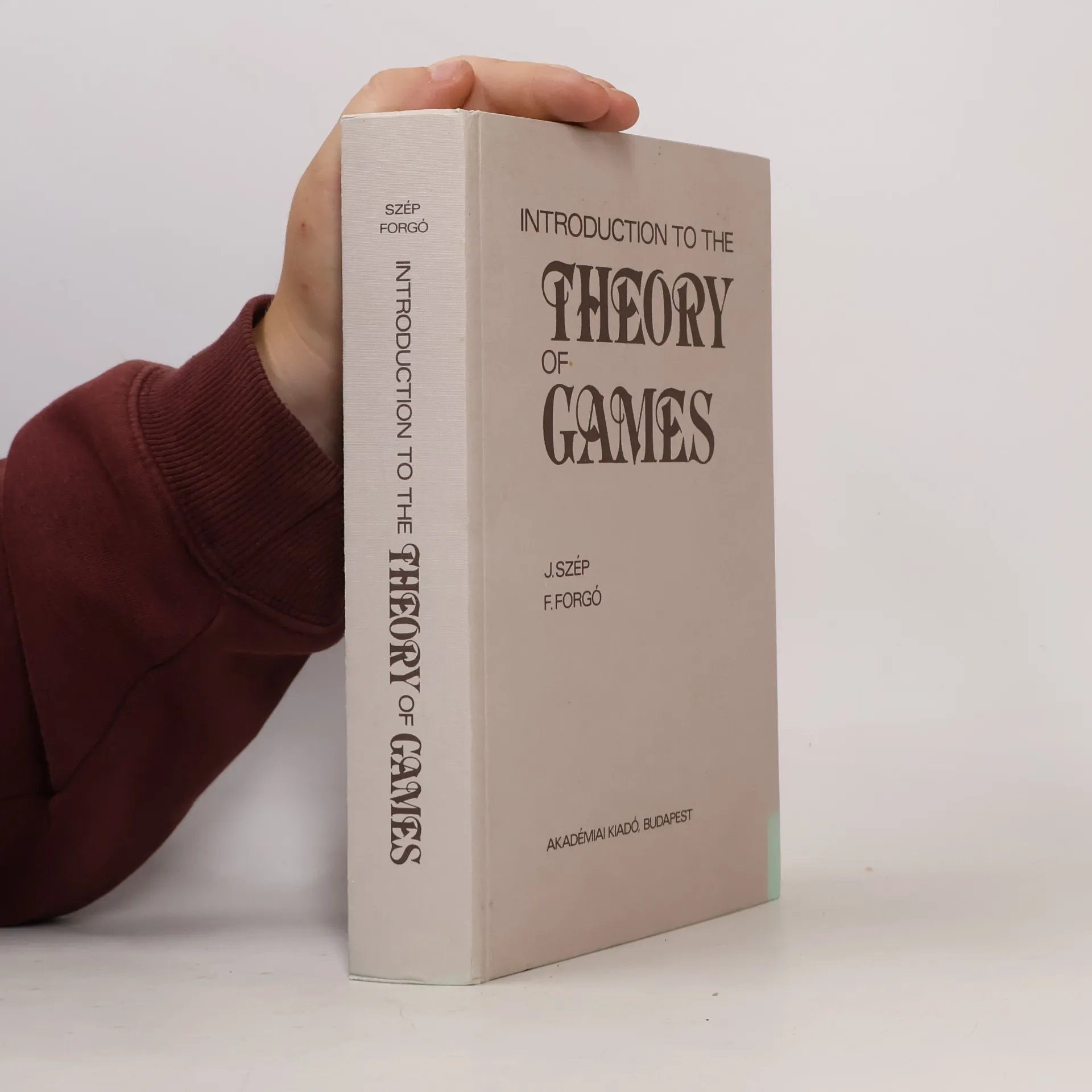



Más información sobre el libro
The book "Introduction to the Theory of Games" dwells upon basic problems and several special properties of n-person games. To read the book requires some knowledge of calculus, linear algebra and mathematical programming. Although it does not pretend to be a monography, it provides an up-to-date overview of numerous branches of game theory. Differential games and games with an infinite number of players are not discussed. Special emphasis is given to methodological aspects which means that more attention is paid to methods for determining solutions of games than it is done in other textbooks. The book also covers subjects which have not yet been discussed elsewhere. Though the notion of Nash-equilibrium predominates the text at the beginning of the book the authors try to put it in a more general setting (by introducing equilibrium sets). The abundant bibliography (213 items) is aimed to provide information and to encourage further research. The book is recommended for researchers both mathematicians and economists, and also for practitioners working on various fields.
Compra de libros
Introduction To The Theory Of Games, Anna J. Szepielak, F. Forgó
- Idioma

- Publicado en
- Encuadernación
- (Tapa dura)
Métodos de pago
Nadie lo ha calificado todavía.
- Título
- Introduction To The Theory Of Games
- Idioma
- Inglés
- Autores
- Anna J. Szepielak, F. Forgó
- Editorial
- Akademiai Kiadó
- Formato
- Tapa dura
- ISBN10
- 963053357X
- ISBN13
- 9789630533577
- Serie
- Descripción
- The book "Introduction to the Theory of Games" dwells upon basic problems and several special properties of n-person games. To read the book requires some knowledge of calculus, linear algebra and mathematical programming. Although it does not pretend to be a monography, it provides an up-to-date overview of numerous branches of game theory. Differential games and games with an infinite number of players are not discussed. Special emphasis is given to methodological aspects which means that more attention is paid to methods for determining solutions of games than it is done in other textbooks. The book also covers subjects which have not yet been discussed elsewhere. Though the notion of Nash-equilibrium predominates the text at the beginning of the book the authors try to put it in a more general setting (by introducing equilibrium sets). The abundant bibliography (213 items) is aimed to provide information and to encourage further research. The book is recommended for researchers both mathematicians and economists, and also for practitioners working on various fields.