



Parámetros
- 608 páginas
- 22 horas de lectura
Más información sobre el libro
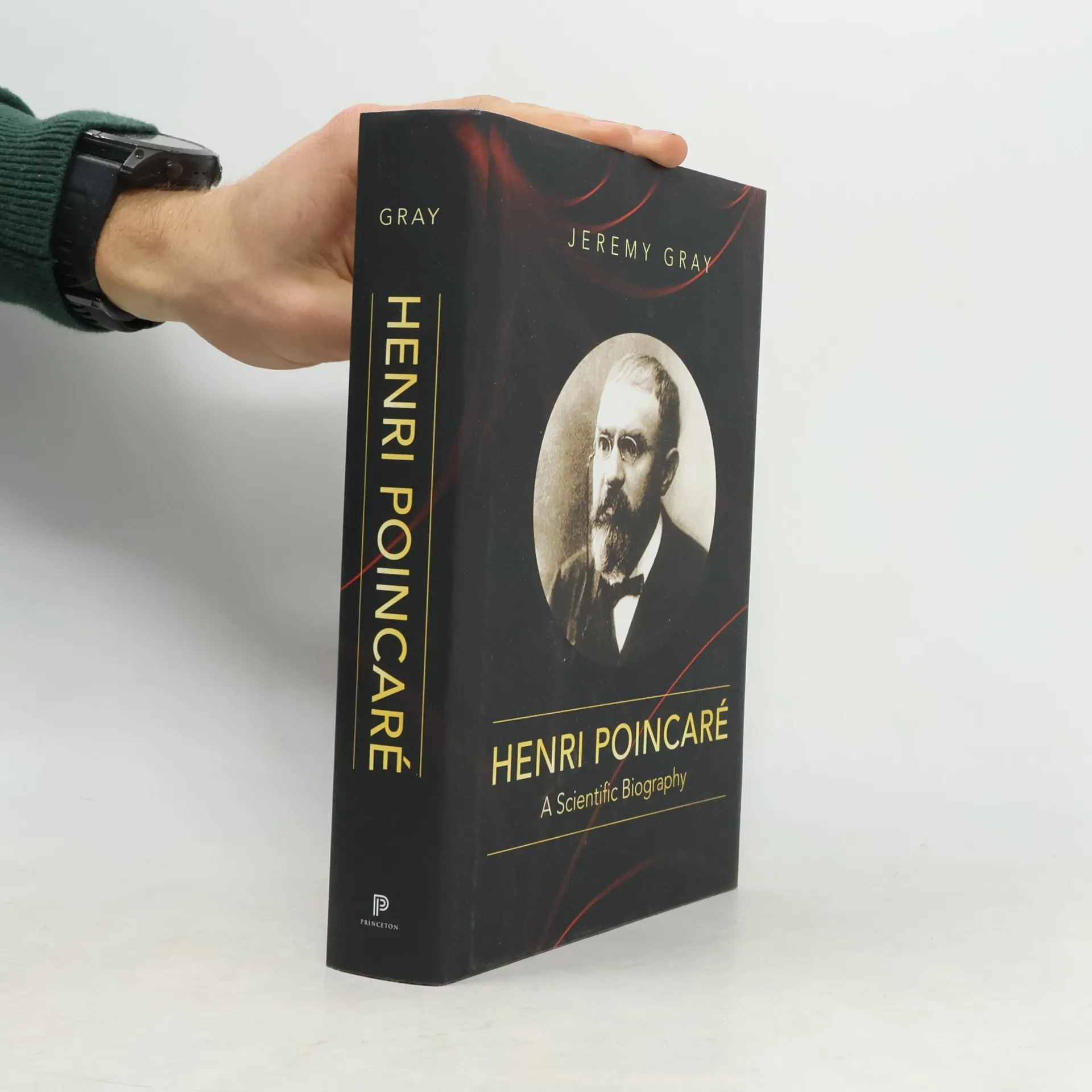
<b>A comprehensive look at the mathematics, physics, and philosophy of Henri Poincar�</b> Henri Poincar� (1854-1912) was not just one of the most inventive, versatile, and productive mathematicians of all time-he was also a leading physicist who almost won a Nobel Prize for physics and a prominent philosopher of science whose fresh and surprising essays are still in print a century later. The first in-depth and comprehensive look at his many accomplishments, <i>Henri Poincar�</i> explores all the fields that Poincar� touched, the debates sparked by his original investigations, and how his discoveries still contribute to society today. Math historian Jeremy Gray shows that Poincar�'s influence was wide-ranging and permanent. His novel interpretation of non-Euclidean geometry challenged contemporary ideas about space, stirred heated discussion, and led to flourishing research. His work in topology began the modern study of the subject, recently highlighted by the successful resolution of the famous Poincar� conjecture. And Poincar�'s reformulation of celestial mechanics and discovery of chaotic motion started the modern theory of dynamical systems. In physics, his insights on the Lorentz group preceded Einstein's, and he was the first to indicate that space and time might be fundamentally atomic. Poincar� the public intellectual did not shy away from scientific controversy, and he defended mathematics against the attacks of logicians such as Bertrand Russell, opposed the views of Catholic apologists, and served as an expert witness in probability for the notorious Dreyfus case that polarized France. Richly informed by letters and documents, <i>Henri Poincar�</i> demonstrates how one man's work revolutionized math, science, and the greater world.
Compra de libros
Henri Poincaré, Jeremy Gray
- Idioma

- Publicado en
- 2013
- Encuadernación
- (Tapa dura),
- Estado del libro
- Bueno
- Precio
- 11,99 €
Métodos de pago
Nadie lo ha calificado todavía.
- Título
- Henri Poincaré
- Subtítulo
- A Scientific Biography
- Idioma
- Inglés
- Autores
- Jeremy Gray
- Editorial
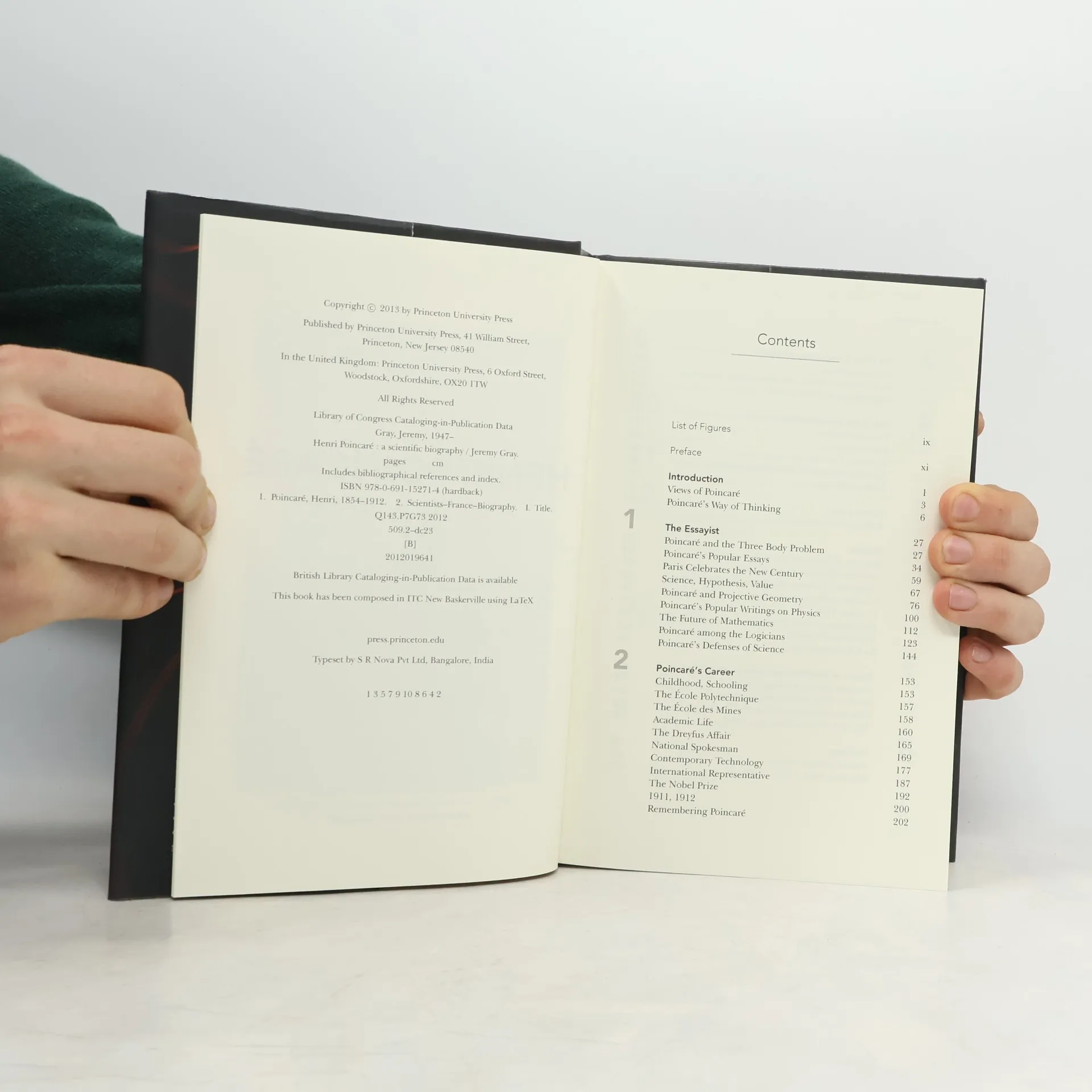
- Princeton University Press
- Publicado en
- 2013
- Formato
- Tapa dura
- Páginas
- 608
- ISBN10
- 0691152713
- ISBN13
- 9780691152714
- Serie
- Categorías
- Etiquetas
- Tema histórico, Ciencia, Francia, Europa Occidental, Científicos
- Descripción
- <b>A comprehensive look at the mathematics, physics, and philosophy of Henri Poincar�</b> Henri Poincar� (1854-1912) was not just one of the most inventive, versatile, and productive mathematicians of all time-he was also a leading physicist who almost won a Nobel Prize for physics and a prominent philosopher of science whose fresh and surprising essays are still in print a century later. The first in-depth and comprehensive look at his many accomplishments, <i>Henri Poincar�</i> explores all the fields that Poincar� touched, the debates sparked by his original investigations, and how his discoveries still contribute to society today. Math historian Jeremy Gray shows that Poincar�'s influence was wide-ranging and permanent. His novel interpretation of non-Euclidean geometry challenged contemporary ideas about space, stirred heated discussion, and led to flourishing research. His work in topology began the modern study of the subject, recently highlighted by the successful resolution of the famous Poincar� conjecture. And Poincar�'s reformulation of celestial mechanics and discovery of chaotic motion started the modern theory of dynamical systems. In physics, his insights on the Lorentz group preceded Einstein's, and he was the first to indicate that space and time might be fundamentally atomic. Poincar� the public intellectual did not shy away from scientific controversy, and he defended mathematics against the attacks of logicians such as Bertrand Russell, opposed the views of Catholic apologists, and served as an expert witness in probability for the notorious Dreyfus case that polarized France. Richly informed by letters and documents, <i>Henri Poincar�</i> demonstrates how one man's work revolutionized math, science, and the greater world.