Stephen Breyer se hizo conocido como profesor y conferenciante en Harvard Law School, especializándose en derecho administrativo y siendo autor de influyentes libros de texto. Es conocido por su enfoque pragmático del derecho constitucional, generalmente asociado con el ala más liberal del Tribunal. En su libro de 2005, expuso su teoría legal que enfatiza la libertad activa y fomenta la participación pública en las decisiones gubernamentales. Su obra se centra en cómo el poder judicial puede resolver mejor los problemas para promover la participación democrática.
Does the death penalty violate the US Constitution? In Against the Death Penalty, Justice Stephen G. Breyer argues that it does: that it is carried out unfairly and inconsistently, and thus violates the ban on cruel and unusual punishments specified by the Eighth Amendment to the Constitution.
Help your students master the principles of administrative law in an era of change with this renowned casebook, "Administrative Law and Regulatory Policy": Problems, Text, and Cases, Fourth Edition. The book correlates issues of regulatory policy with doctrinal problems to explore the relationship between administrative government and democratic goals. Their extensively revised casebook now offers more explanatory materials, more concise text, many new cases, and reorganized material for greater accessibility. New co-authors Cass Sunstein and Matthew Spitzer join administrative law authorities Stephen Breyer and Richard Stewart to offer a matchless view of administrative law, including: -- how agencies promote -- or compromise -- political legitimacy -- how different understandings of democracy bear on evaluation of administrative government -- the multiple purposes of administrative agencies
Edited and introduced by former Supreme Court Justice Breyer's former law clerk--and accompanied by a sobering update on the state of segregated schools in America today--this volume contains the full text of Breyer's most impassioned opinion, a dissent that Justice John Paul Stevens called at the time "eloquent and unanswerable."swerable."
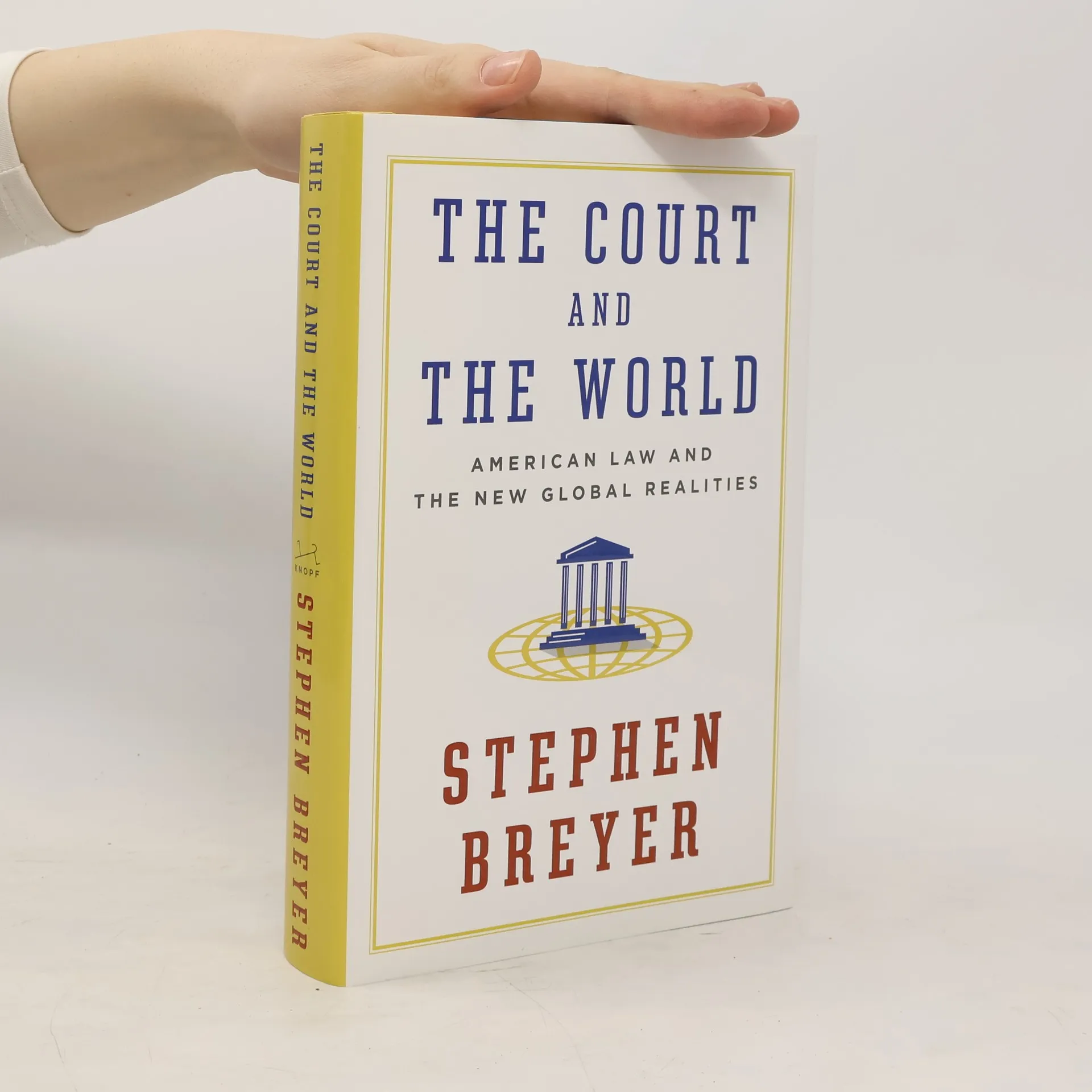
"Justice Stephen Breyer examines the work of SCOTUS in an increasingly interconnected world, a world in which all sorts of public and private activity--from the conduct of national security policy to the conduct of international trade--obliges the Court to consider and understand circumstances beyond America's borders. At a time when ordinary citizens may book international lodging directly through online sites like Airbnb, it has become clear that judicial awareness can no longer stop at the water's edge"--
The Supreme Court plays a crucial role in interpreting the Constitution, wielding the power to invalidate laws passed by elected officials. This raises important questions about public acceptance of the Court's decisions, especially when they are unpopular. Justice Stephen Breyer explores these issues, emphasizing that public confidence in the Court is not guaranteed. He highlights historical instances where the Court's rulings were disregarded, using cases involving the Cherokee Indians, slavery, and Brown v. Board of Education to illustrate the Court's journey toward legitimacy.
Breyer argues for a pragmatic approach to constitutional interpretation, one that adapts enduring values to contemporary circumstances, rather than strictly adhering to the text or the framers' 18th-century perspectives. He stresses the importance of the Court respecting the roles of other governmental entities—such as the president, Congress, and states—and fostering cooperative relationships with them.
Additionally, Breyer contrasts recent decisions regarding Guantánamo Bay detainees with the internment of Japanese-Americans during World War II, demonstrating how the Court can uphold constitutional principles while promoting effective governance. This work combines historical insight with philosophical inquiry, presenting a fresh perspective on constitutional interpretation that will resonate with judges, lawyers, and scholars for years to come,
Based on the Tanner lectures delivered by Justice Stephen Breyer at Harvard in November 2004, this book defines “active liberty” as the sharing of sovereign authority between the nation and its citizens. Breyer views the Constitution not as a rigid legal framework but as a living guide that adapts to a changing society. He emphasizes that the Constitution's true genius lies in its principles' ability to address contemporary issues rather than adhering to a static interpretation. Through examples in free speech, federalism, privacy, affirmative action, statutory interpretation, and administrative law, Breyer argues that courts should recognize the Constitution’s democratic nature when interpreting texts. He asserts that citizens must engage in community life to gain the experience needed for self-governance. Breyer's unique perspective in the federalism debate posits that deference to congressional power can enhance democratic participation. He contends that, despite its imperfections, Congress has effectively balanced diverse citizen views, especially during crises, better than the executive or judicial branches. With a nuanced understanding of complexity, Breyer advocates for Congress as the appropriate forum for resolving policy disputes, making a significant declaration about democracy and governance.
On its Surface, this book is aimed at the topical issue of regulatory reform. But underneath it strives to go beyond the topical, seeking to analyze regulation as a distinct discipline and to help teach it as a separate subject