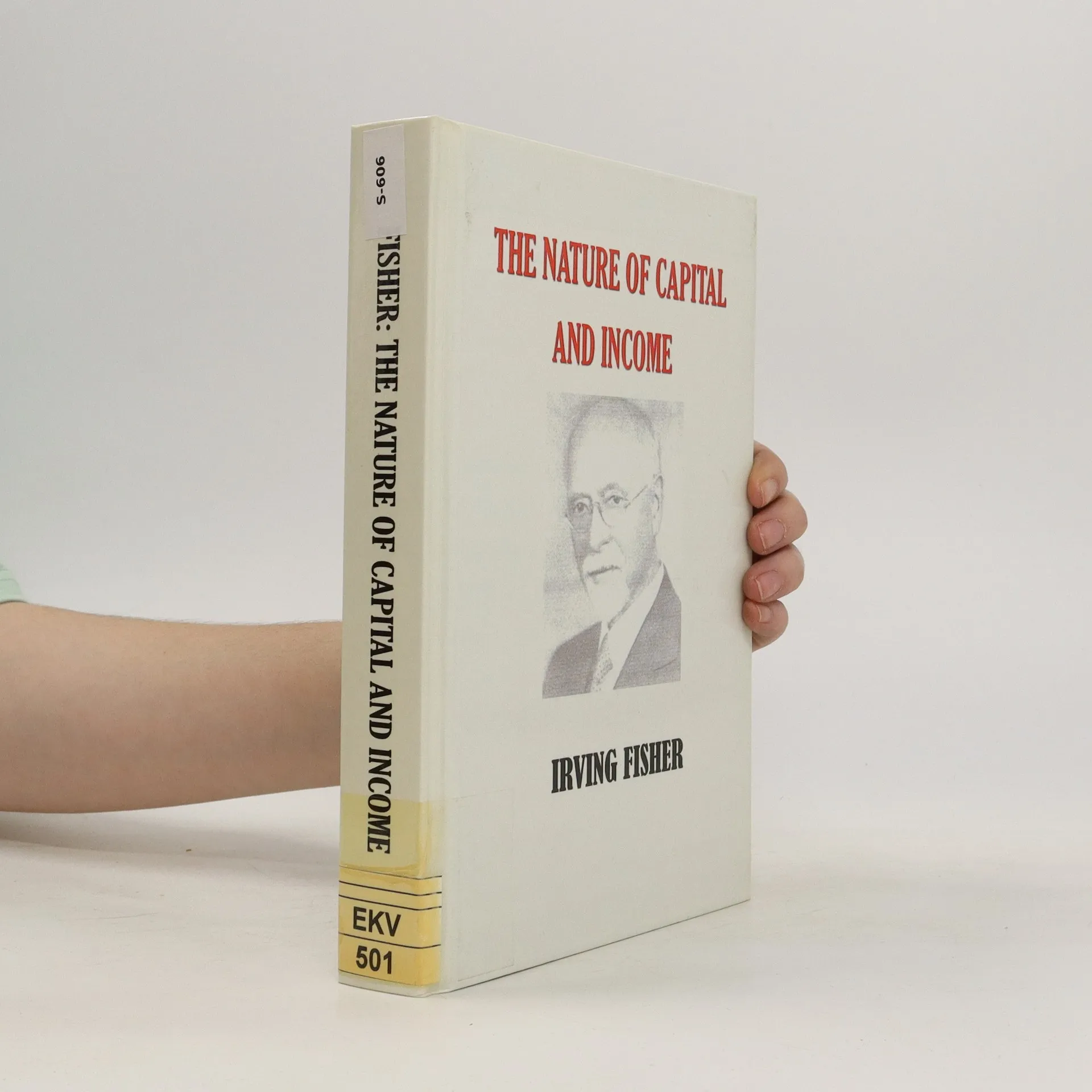
Irving Fisher fue un economista estadounidense cuyas obras sentaron las bases de muchas teorías económicas modernas. Hizo contribuciones significativas a la teoría de la utilidad, el equilibrio general y fue pionero en el estudio riguroso de la elección intertemporal en los mercados, lo que llevó a su teoría del capital y las tasas de interés. Su investigación sobre la teoría cuantitativa del dinero se considera el inicio del monetarismo. Aunque su reputación se vio dañada por sus predicciones bursátiles, sus teorías posteriores sobre la deflación de la deuda y su trabajo sobre capital e interés siguen siendo influyentes.
The volume features two seminal works by Irving Fisher, a pioneer in modern finance. It explores his influential concepts, including the Fisher equation, hypothesis, and separation theorem, which have shaped economic theory. Fisher's insights into interest rates and capital markets provide a foundational understanding of financial principles that continue to resonate in contemporary economics.
This book delves into the intricate relationship between wealth, income, and capital, exploring how various factors influence purchasing power and monetary systems. It examines the dynamics of supply and demand, the principles governing interest rates, and the impact of impatience for income on financial decisions. Additionally, the text discusses the causes and effects of price variations, as well as the interplay between income from labor and capital. Ultimately, it provides insights into wealth distribution and its implications for welfare and societal structures.
Rules for Healthful Living Based on Modern Science
384 páginas
14 horas de lectura
Irving Fisher's interest in public health was the result of a bout with tuberculosis, after which he wrote "How to Rules for Healthful Living Based on Modern Science". In his foreword to the book, former president and then-future Chief Justice William Howard Taft wrote that there were many "considerations that have influenced me to cooperate with the life extension movement, and to commend this volume to the earnest consideration of all who desire authoritative guidance in improving their own physical condition or in making effective the knowledge now available for bringing health and happiness to our people." To do that, the authors present chapters on the air, food, poisons, activities, and general hygiene, followed by sections dealing with being overweight or underweight, alcohol, posture, and tobacco -- and even how to avoid colds. Irving Fisher was a top American economist in the early 20th century who earned the first Ph.D. in economics awarded by Yale University, where he also taught political economy. He was an accomplished mathematician and an engaging and talented writer on even the most technical of subjects whose investigations ranged beyond economics to encompass astronomy, health and hygiene, mechanics, philosophy, poetry, science, and myriad public policy issues. Dr. Eugene Lyman Fisk was the chairman of the Life Extension Institute, under whose auspices this book was published.
Příručka rozumné životosprávy podle moderních vědeckých zásad. Zdraví je základ, na němž spočívá štěstí národa a síla země! Uvědomte si to! Tato kniha Vám poradí, jak si zdraví udržeti, a bude Vám rádcem, který nikdy neselže!