




Bookbot

David MacKay

    David MacKay fue profesor en el Departamento de Física de la Universidad de Cambridge. Estudió Ciencias Naturales en Cambridge y luego obtuvo su doctorado en Sistemas de Computación y Neuronales en el Instituto de Tecnología de California. Regresó a Cambridge como investigador de la Royal Society en el Darwin College. Fue conocido internacionalmente por su investigación en aprendizaje automático, teoría de la información y sistemas de comunicación, incluida la invención de Dasher, una interfaz de software que permite una comunicación eficiente en cualquier idioma con cualquier músculo. Ha impartido Física en Cambridge desde 1995. Desde 2005, dedicó gran parte de su tiempo a la enseñanza pública sobre energía. Fue miembro del Consejo de Agenda Global sobre el Cambio Climático del Foro Económico Mundial.

    Wohnungsbau im Wandel
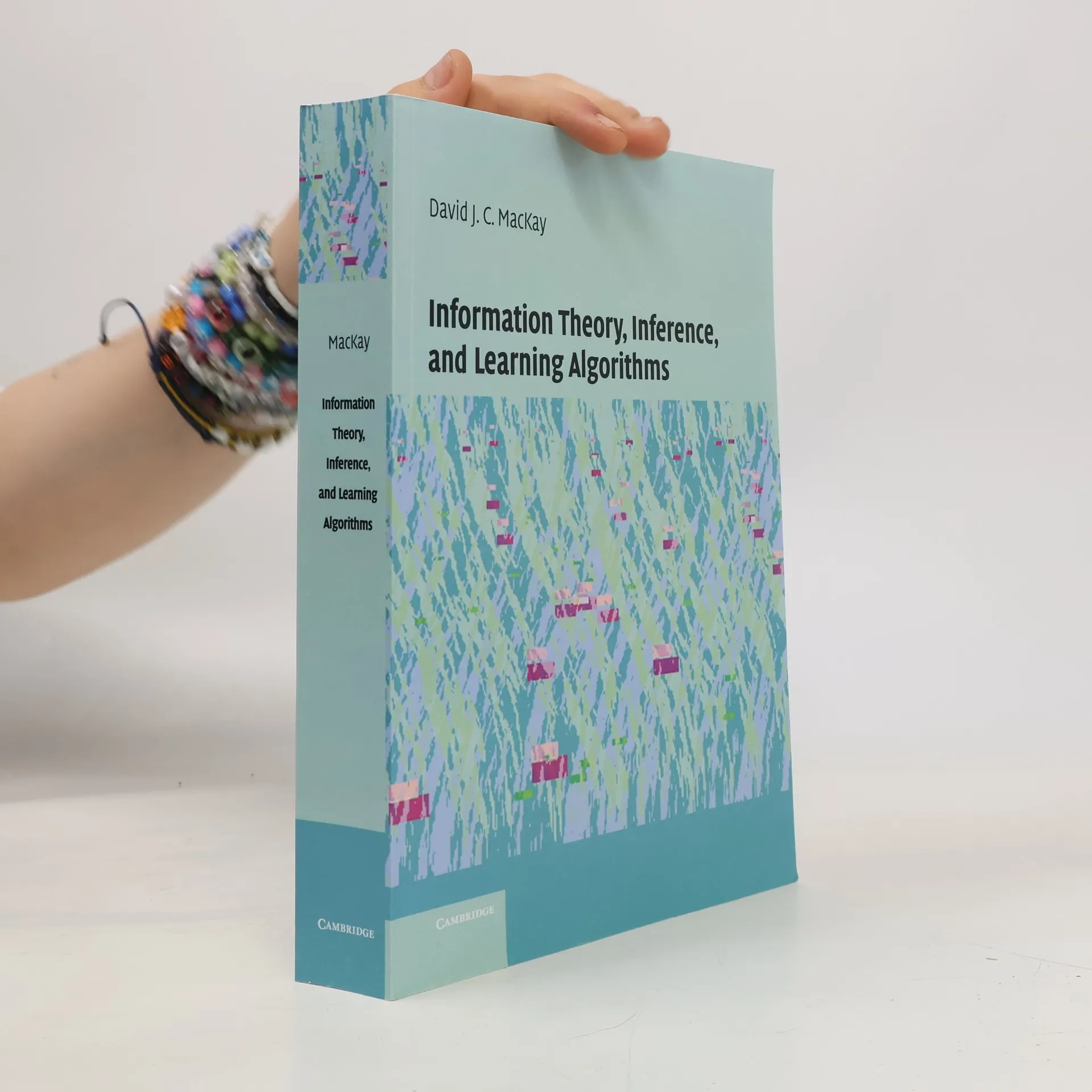
    Information Theory, Inference, and Learning Algorithms
    Big and Little
    The Cat, the Bird, and the Tree
    Schaum's Outline of Tensor Calculus
    Sustainable Energy - Without the Hot Air
    • Sustainable Energy - Without the Hot Air

      • 384 páginas
      • 14 horas de lectura

      Addressing the sustainable energy crisis in an objective manner, this enlightening book analyzes the relevant numbers and organizes a plan for change on both a personal level and an international scale—for Europe, the United States, and the world. In case study format, this informative reference answers questions surrounding nuclear energy, the potential of sustainable fossil fuels, and the possibilities of sharing renewable power with foreign countries. While underlining the difficulty of minimizing consumption, the tone remains positive as it debunks misinformation and clearly explains the calculations of expenditure per person to encourage people to make individual changes that will benefit the world at large.

      Sustainable Energy - Without the Hot Air
      4,5
    • Schaum's Outline of Tensor Calculus

      • 224 páginas
      • 8 horas de lectura

      Confusing Textbooks? Missed Lectures? Not Enough Time? Fortunately for you, there's Schaum's. More than 40 million students have trusted Schaum's to help them succeed in the classroom and on exams. Schaum's is the key to faster learning and higher grades in every subject. Each Outline presents all the essential course information in an easy-to-follow, topic-by-topic format. You also get hundreds of examples, solved problems, and practice exercises to test your skills. This Schaum's Outline gives you

      Schaum's Outline of Tensor Calculus
      3,9
    • Information theory and inference, typically taught separately, are combined in this engaging textbook, central to various fields such as communication, signal processing, data mining, machine learning, and bioinformatics. The text introduces theory alongside practical applications, covering communication systems like arithmetic coding for data compression and sparse-graph codes for error correction. A comprehensive toolbox of inference techniques, including message-passing algorithms, Monte Carlo methods, and variational approximations, is developed alongside applications in clustering, convolutional codes, independent component analysis, and neural networks. The book also explores advanced error-correcting codes, such as low-density parity-check codes, turbo codes, and digital fountain codes, which are essential for modern satellite communications, disk drives, and data broadcasting. Richly illustrated with worked examples and over 400 exercises, some with detailed solutions, this groundbreaking work is suitable for self-study as well as undergraduate and graduate courses. Interludes on crosswords, evolution, and sex add an entertaining touch. Overall, this textbook serves as an invaluable resource for students and professionals in diverse fields, including computational biology, financial engineering, and machine learning.

      Information Theory, Inference, and Learning Algorithms