

Julius T. Tou Libros

Engineering has long been thought of by the public as a profession tra ditionally categorized into such branches as electrical, mechanical, chemical, industrial, civil, etc. This classification has served its purpose for the past half century; but the last decade has witnessed a tremendous change. A continuous transition from the practical to the theoretical has made technology overlap with science, and the enlargement of scope and broad ened diversification have smeared the boundaries between traditional engi neering and scientific fields. Engineering is rapidly becoming a diversified, multidisciplinary field of scientific endeavor. This has prompted us to regard modern engineering as a science, which has as its ingredients materials, energy, and information. In our complex and technologically-oriented society organizations are flooded with an enormous amount of management information. We are now faced with problems concerning the efficient use of communicated knowledge. The steady growth in the magnitude and complexity of informa tion systems necessitates the development of new theories and techniques for solving these information problems. We demand instant access to pre viously recorded information for decision making, and we require new meth ods for analysis, recognition, processing, and display. As a consequence, information science has evolved out of necessity. Concerned with the theoretical basis of the organization, control, stor age, retrieval, processing, and communication of information both by natural and artificial systems, information science is multidisciplinary in character. It covers a vast area of subject matter in the physical and biological sciences."
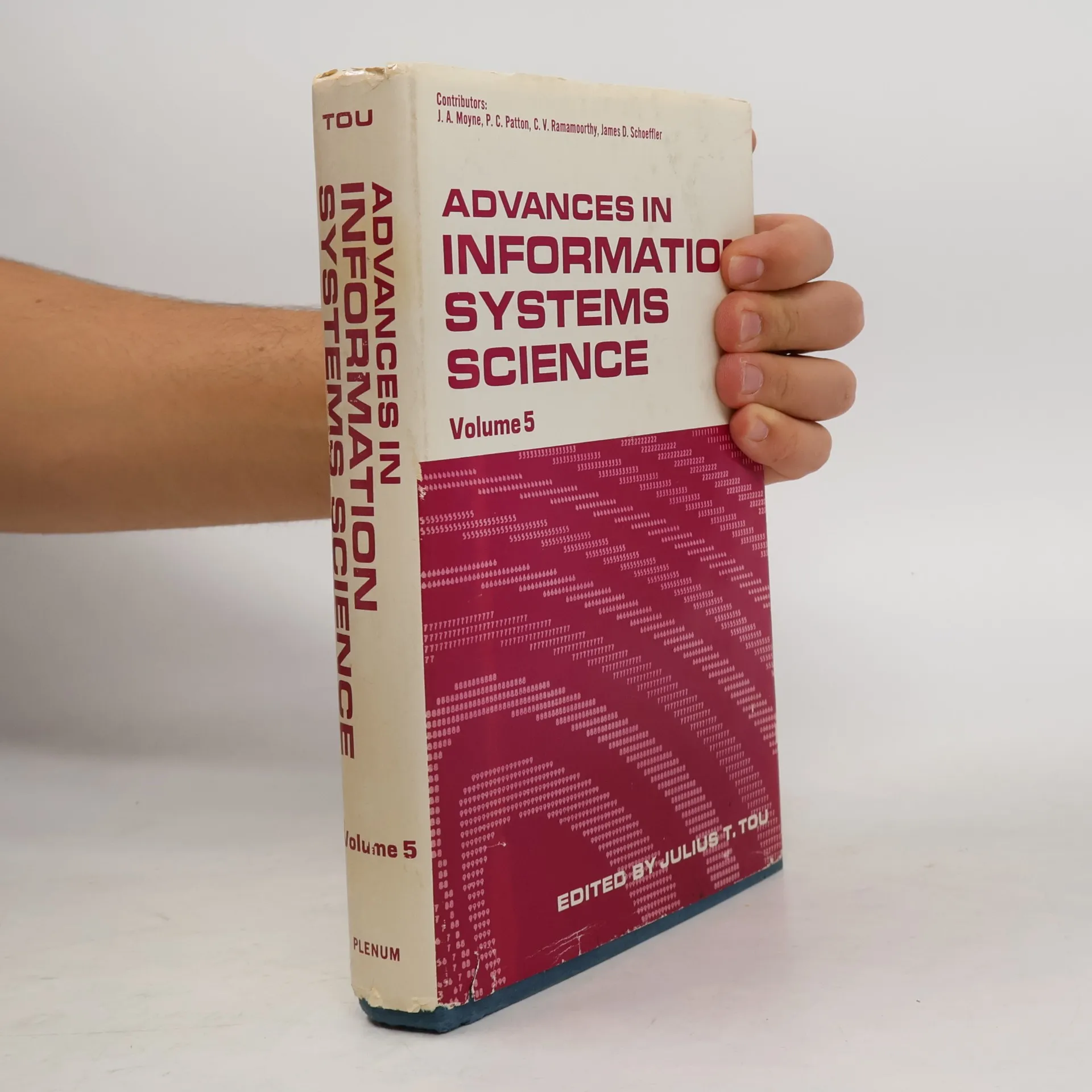
Advances in Information Systems Science
- 343 páginas
- 13 horas de lectura
This volume, the fifth of a continuing series on information systems science, covers four timely topics which are in the mainstream of this field. In each chapter, an attempt is made to familiarize the reader with basic background information on the advances discussed, so that this volume may be used independently or in conjunction with the previous volumes. The emphasis in this volume is focused upon data organization and access methods, software for on-line minicomputer applications, advances in micropro graming, and gramm ars and recognizers for formal and natural languages. In Chapter 1, P. C. Patton presents a tutorial survey of data organiza tion and access methods which play a central role in information system design. Research in information processing has been shifted from numerical data processing to nonnumerical information handling. In the latter case, the information is carried not only by the data but also by the structure and organization of the data base. In this chapter, the author provides the reader with a comprehensive review of various data structures, including linear lists, array structures, tree structures, and multilinked structures. He also discusses the important problem of data-base design and management. This chapter concludes with several examples of information handling systems such as a matrix interpretive system, a generalized information management system, and a criminal justice information system. The rapid reduction in cost and great increase in capability of the mini computer have made it an attractive machine for information systems."