

Compra 10 libros por 10 € aquí!
Bookbot

Gerhard Börner

    1 de enero de 1941
    Gravitation
    Kosmologie
    Schöpfung ohne Schöpfer?
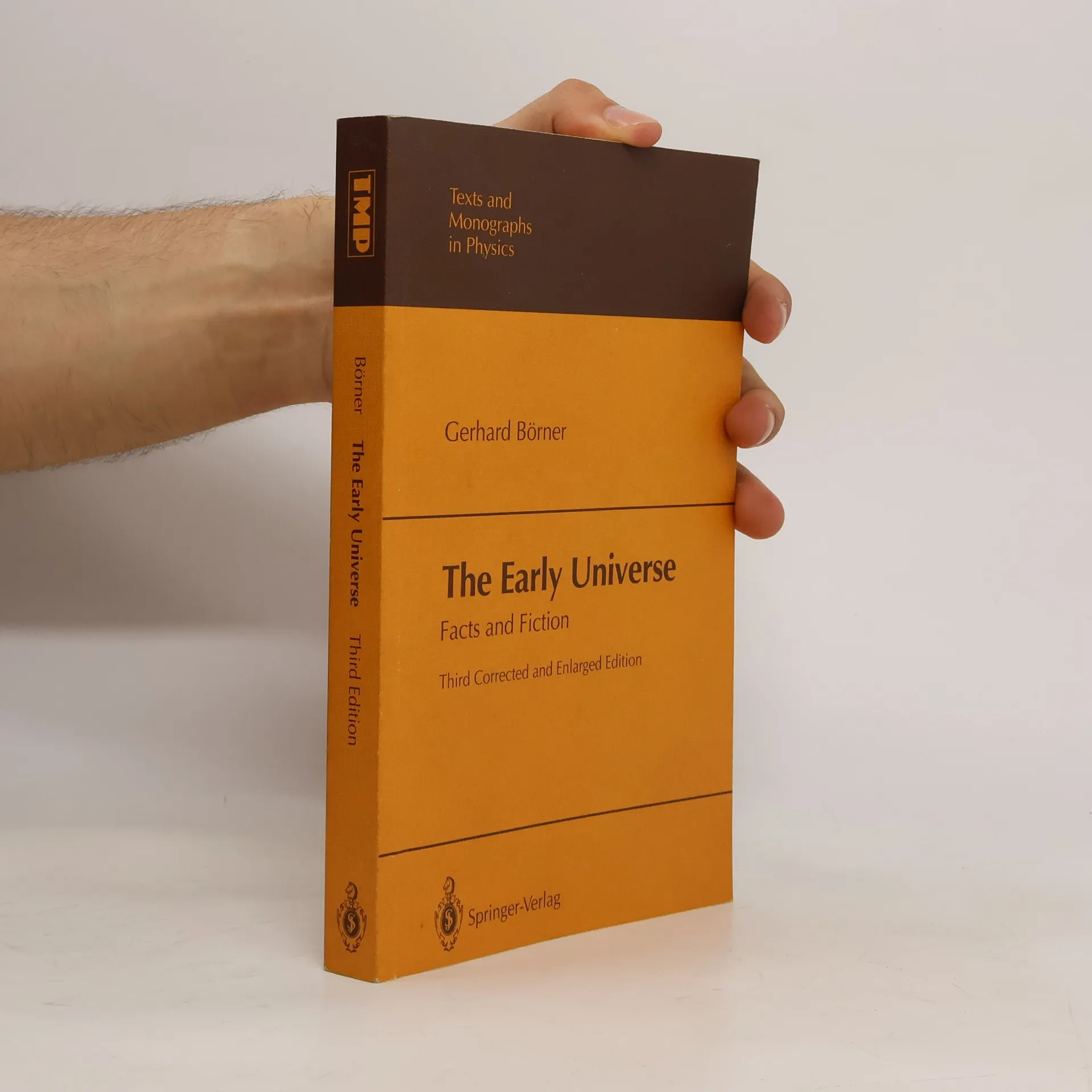
    The Early Universe
    The Early Universe
    • The Early Universe

      • 466 páginas
      • 17 horas de lectura

      In this corrected and enlarged edition of Börner's well respected textbook, you will find an up-to-date account of the interplay between particle physics and astrophysics upon which modern cosmology is founded. The author describes some of the theories which have been developed to model the fundamental interaction of elementary particles in the extremely high temperatures of the early universe, taking care to distinguish facts and well- established results from hypotheses and speculations. The three parts of the book discuss the standard hot big bang model of the early universe, the basic ideas of the standard and the grand unified theories of elementary particles, and the influence of dark matter of the large- scale evolution of structure. In addition to making some minor corrections, the author has added an appendix presenting new results and an updated bibliography. Two main groups of readers are research students in astronomy can use this book to understand the impact of elementary particle theory on cosmology, while research students in particle physics can use it to acquaint themselves with the basic facts of cosmology. The book is written carefully enough to appeal also to a wider audience of physicists.

      The Early Universe
    • The Early Universe

      Facts and Fiction

      • 593 páginas
      • 21 horas de lectura

      This fourth edition of the book offers a comprehensive review of advancements in cosmology over the last fourteen years. It features newly written chapters on the standard model, quantum field theory implications, and structure formation. Emphasis is placed on recent observations, particularly of cosmic microwave background anisotropies.

      The Early Universe
    • Die alten Fragen „Woher kommen wir?“, „Wohin gehen wir?“ haben in der modernen Kosmologie eine interessante Antwort erhalten. Wir sind Teil einer langen Kette von Entwicklungen in einem Kosmos, in dem kein Atom verlorengeht und in dem unser Leben sogar mit der Entwicklung der Sterne verknüpft ist. Die frappierenden Erkenntnisse der Physiker über die komplexe Struktur des Universums, in dem unsere solide Alltagswelt offenbar getragen wird von einem Untergrund aus Teilchen und immateriellen Feldern, führen zu einem Verzicht auf eine umfassende Weltdeutung. Sie öffnen aber den Blick für die Bedeutung von Glaubensaussagen. Gerhard Börner erkundet die Grenzen der naturwissenschaftlichen Weltbeschreibung und liefert einen spannenden Beitrag zur Diskussion zwischen naturwissenschaftlichen und religiösen Weltsichten.

      Schöpfung ohne Schöpfer?
    • Kosmologie

      Eine Einführung

      Die Evolution des Universums: Vom Urknall zur komplexen Welt der Galaxien Für jedermann verständlich erklärt Börner in seiner kurz und bündig geschriebenen ›Kosmologie‹ die Mysterien unseres Universums wie die Ausdehnung des Weltalls, Kugelsternhaufen, kosmische Hintergrundstrahlung und Schwarze Löcher. Und er führt ein in Kosmologische Modelle, Gravitation und die Allgemeine Relativitätstheorie.

      Kosmologie