



Parámetros
- 706 páginas
- 25 horas de lectura
Más información sobre el libro
This extraordinary magnum opus seems at first to be a confessional autobiographical novel in the grand manner, claiming and extending the legacy of Proust and Mann. But it is more: Peter Nadas has given us a superb contemporary psychological novel that comes to terms with the ghosts, corpses, and repressed nightmares of Europe's recent past. "A Book of Memories" is made up of three first-person narratives: the first that of a young Hungarian writer and his fated love for a German poet; we also learn of the narrator's adolescence in Budapest, when he experiences the downfall of his once-upper-class but now pro-Communist family and of his beloved but repudiated father, a state prosecutor who commits suicide after the 1956 uprising. A second memoir, alternating with the first, is a novel the narrator is composing about a refined Belle Epoque aesthete, whose anti-bourgeois transgressions seem like emotionally overcharged versions of the narrator's own experiences. A third voice is that of a childhood friend who, after the narrator's return to his homeland, offers an apparently more objective account of their friendship. Together these brilliantly colored lives are integrated in a powerful work of tragic intensity.




Compra de libros
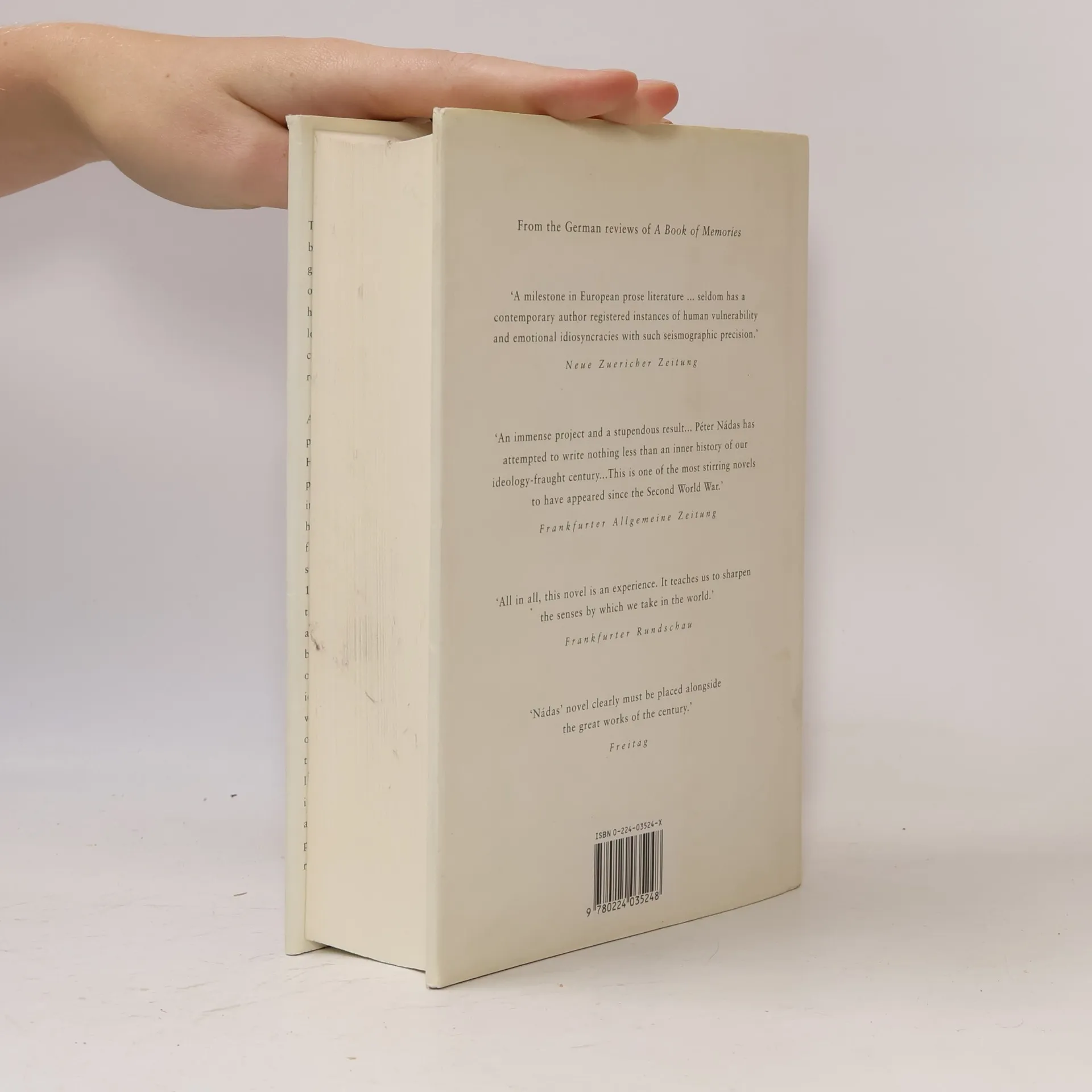
A Book of Memories, Péter Nádas
- Idioma

- Publicado en
- 1997
- Encuadernación
- (Tapa dura)
Métodos de pago
Nos falta tu reseña aquí
- Título
- A Book of Memories
- Idioma
- Inglés
- Autores
- Péter Nádas
- Editorial
- Jonathan Cape
- Publicado en
- 1997
- Formato
- Tapa dura
- Páginas
- 706
- ISBN10
- 022403524X
- ISBN13
- 9780224035248
- Serie
- Categorías
- Etiquetas
- Hungría, Literatura húngara, Europa del Este, Los Años 50 del Siglo XX, Años 70 del siglo XX
- Primera publicación
- 1994
- Título original
- Emlékiratok könyve
- Calificación
- 4,05 de 5
- Descripción
- This extraordinary magnum opus seems at first to be a confessional autobiographical novel in the grand manner, claiming and extending the legacy of Proust and Mann. But it is more: Peter Nadas has given us a superb contemporary psychological novel that comes to terms with the ghosts, corpses, and repressed nightmares of Europe's recent past. "A Book of Memories" is made up of three first-person narratives: the first that of a young Hungarian writer and his fated love for a German poet; we also learn of the narrator's adolescence in Budapest, when he experiences the downfall of his once-upper-class but now pro-Communist family and of his beloved but repudiated father, a state prosecutor who commits suicide after the 1956 uprising. A second memoir, alternating with the first, is a novel the narrator is composing about a refined Belle Epoque aesthete, whose anti-bourgeois transgressions seem like emotionally overcharged versions of the narrator's own experiences. A third voice is that of a childhood friend who, after the narrator's return to his homeland, offers an apparently more objective account of their friendship. Together these brilliantly colored lives are integrated in a powerful work of tragic intensity.