

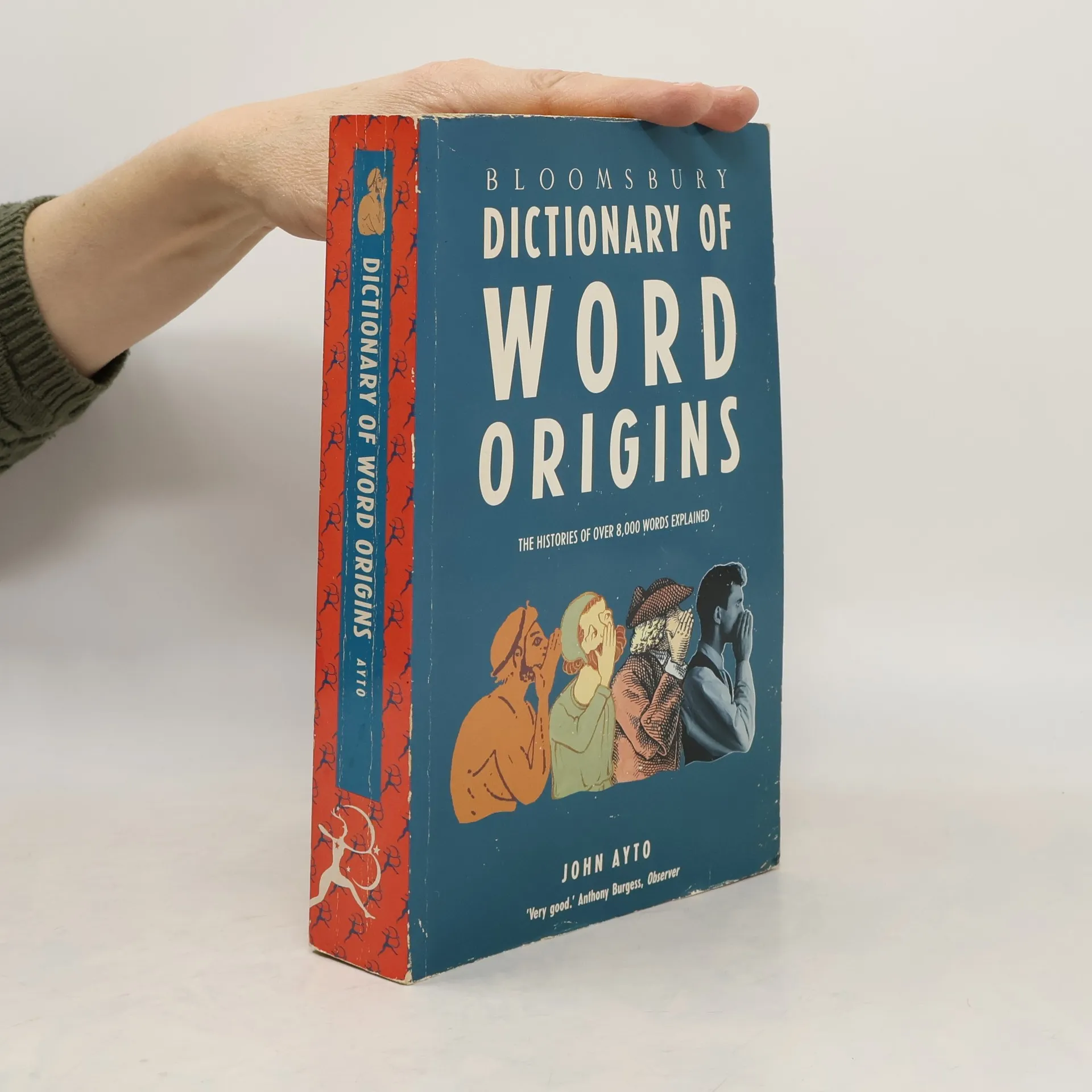
Bloomsbury Dictionary of Word Origins
The Histories of Over 8,000 Words Explained
Autores
Valoración del libro
Parámetros
- 582 páginas
- 21 horas de lectura
Más información sobre el libro
The average English speaker knows 50,000 words in contemporary use - 25 more words than there are stars in the night sky visible to the naked eye. Yet stripped down to its origins, this apparently huge vocabulary is in reality a much smaller number of words from Latin, French and the Germanic languages. It is estimated that every year, 800 neologisms are added to the English language: acronyms - 'yuppie', blended words - 'motel', and those taken from foreign languages - 'savoir-faire'. The Bloomsbury Dictionary of Word Origins provides a concise history of over 8,000 of the most commonly used words. The range of information spans from derivations as simple as 'a' and 'one' from 'an', to historical relations between words which would be obscure to all but the most lexically-minded. For instance 'vice' with its several uses in English - a wickedness, a holding tool - is derived via Old French from two separate Latin words: 'vitium' (defect, offence), and 'vitis' (vine) which gave 'viticulture'. The Bloomsbury Dictionary of Word Origins demonstrates how the diverse influences on English have given rise to some unlikely but fascinating lexical relations. 'Bishop' had no ecclesiastical


Compra de libros
Bloomsbury Dictionary of Word Origins, John Ayto
- Idioma

- Publicado en
- 1991
- Encuadernación
- (Tapa blanda)
Métodos de pago
Nos falta tu reseña aquí
- Título
- Bloomsbury Dictionary of Word Origins
- Subtítulo
- The Histories of Over 8,000 Words Explained
- Idioma
- Inglés
- Autores
- John Ayto
- Editorial
- Bloomsbury Publishing PLC
- Publicado en
- 1991
- Formato
- Tapa blanda
- Páginas
- 582
- ISBN10
- 0747509719
- ISBN13
- 9780747509714
- Serie
- Etiquetas
- Tema histórico, Diccionarios y libros de texto de idiomas, Guías y Manuales, Diccionarios lingüísticos, Diccionarios, Escritura, Libros de texto de historia
- Calificación
- 4,35 de 5
- Descripción
- The average English speaker knows 50,000 words in contemporary use - 25 more words than there are stars in the night sky visible to the naked eye. Yet stripped down to its origins, this apparently huge vocabulary is in reality a much smaller number of words from Latin, French and the Germanic languages. It is estimated that every year, 800 neologisms are added to the English language: acronyms - 'yuppie', blended words - 'motel', and those taken from foreign languages - 'savoir-faire'. The Bloomsbury Dictionary of Word Origins provides a concise history of over 8,000 of the most commonly used words. The range of information spans from derivations as simple as 'a' and 'one' from 'an', to historical relations between words which would be obscure to all but the most lexically-minded. For instance 'vice' with its several uses in English - a wickedness, a holding tool - is derived via Old French from two separate Latin words: 'vitium' (defect, offence), and 'vitis' (vine) which gave 'viticulture'. The Bloomsbury Dictionary of Word Origins demonstrates how the diverse influences on English have given rise to some unlikely but fascinating lexical relations. 'Bishop' had no ecclesiastical