

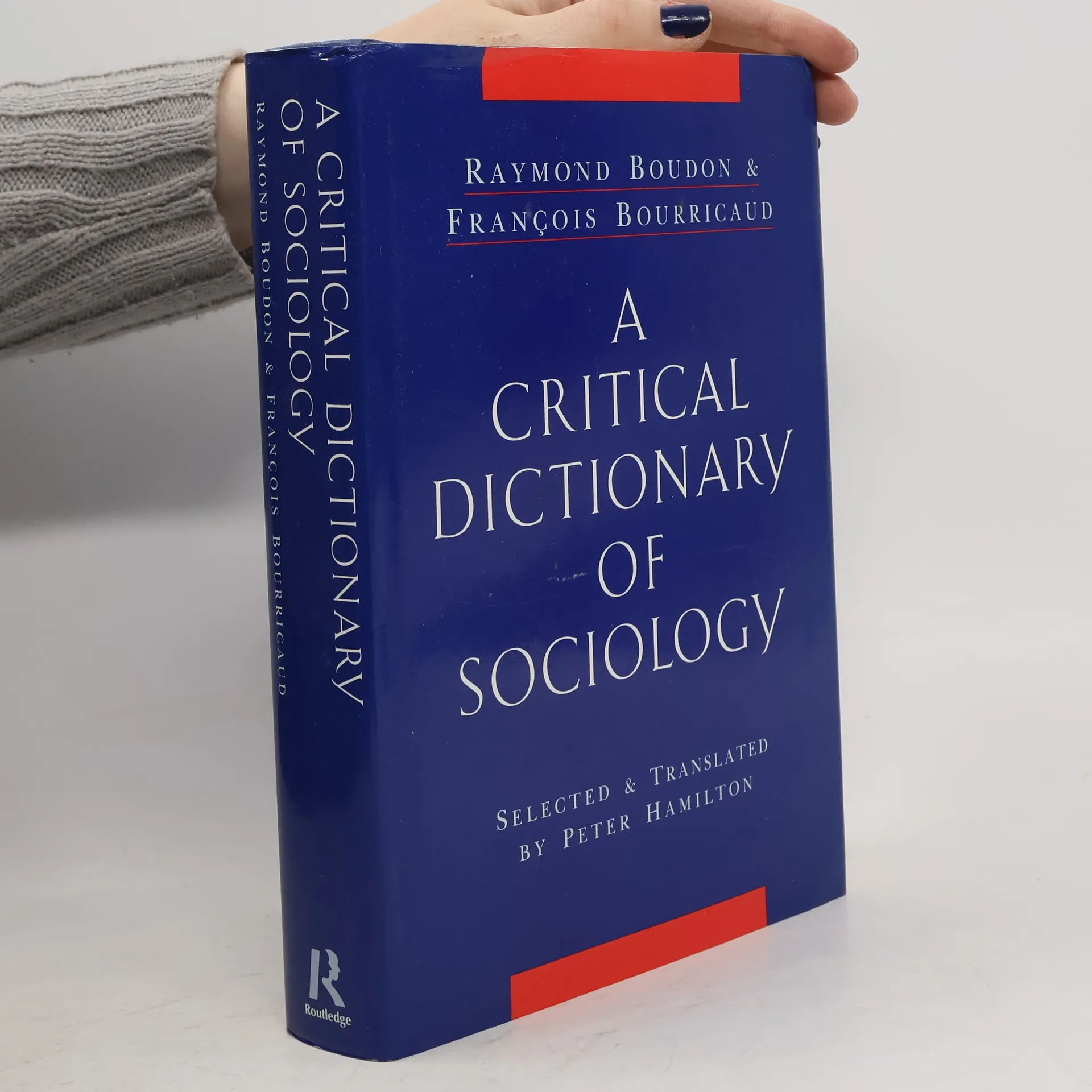
Más información sobre el libro
Unlike most other sociology or social science dictionaries, in this translation of the Critical Dictionary of Sociology , taken from the second French edition of the Dictionary and edited by the English sociologist Peter Hamilton, the critical value of this distinctive work is at last made available for a wider audience. Each entry grapples directly with an issue, whether theoretical, epistemological, philosophical, political or empirical, and provides a strong statement of what the authors think about it. The discussions are considered but argumentative. By reaffirming that a non-marxist style of critique is still possible, Boudon and Bourricaud have presented a distinctive approach to the key issues which confront the societies of the Twentieth and Twenty-First centuries. For some this work will be a textbook, for others an indispensable sourcebook of sociological concepts, and for most a way of opening our eyes to new dimensions in our understanding of the great ideas and theories of sociology.


Compra de libros
A Critical Dictionary of Sociology, Raymond Boudon, François Bourricaud, Peter Hamilton
- Idioma

- Publicado en
- 1989
- Encuadernación
- (Tapa dura)
Métodos de pago
Nadie lo ha calificado todavía.
- Título
- A Critical Dictionary of Sociology
- Idioma
- Inglés
- Editorial
- Routledge
- Publicado en
- 1989
- Formato
- Tapa dura
- Páginas
- 452
- ISBN10
- 0415017459
- ISBN13
- 9780415017459
- Serie
- Etiquetas
- Sociedad
- Título original
- Dictionnaire de sociologie
- Descripción
- Unlike most other sociology or social science dictionaries, in this translation of the Critical Dictionary of Sociology , taken from the second French edition of the Dictionary and edited by the English sociologist Peter Hamilton, the critical value of this distinctive work is at last made available for a wider audience. Each entry grapples directly with an issue, whether theoretical, epistemological, philosophical, political or empirical, and provides a strong statement of what the authors think about it. The discussions are considered but argumentative. By reaffirming that a non-marxist style of critique is still possible, Boudon and Bourricaud have presented a distinctive approach to the key issues which confront the societies of the Twentieth and Twenty-First centuries. For some this work will be a textbook, for others an indispensable sourcebook of sociological concepts, and for most a way of opening our eyes to new dimensions in our understanding of the great ideas and theories of sociology.