



Más información sobre el libro
An accessible introduction to string theory, this book provides a detailed and self-contained demonstration of the main concepts involved. The first part deals with basic ideas, reviewing special relativity and electromagnetism while introducing the concept of extra dimensions. D-branes and the classical dynamics of relativistic strings are discussed next, and the quantization of open and closed bosonic strings in the light-cone gauge, along with a brief introduction to superstrings. The second part begins with a detailed study of D-branes followed by string thermodynamics. It discusses possible physical applications, and covers T-duality of open and closed strings, electromagnetic fields on D-branes, Born/Infeld electrodynamics, covariant string quantization and string interactions. Primarily aimed as a textbook for advanced undergraduate and beginning graduate courses, it will also be ideal for a wide range of scientists and mathematicians who are curious about string theory.
Compra de libros
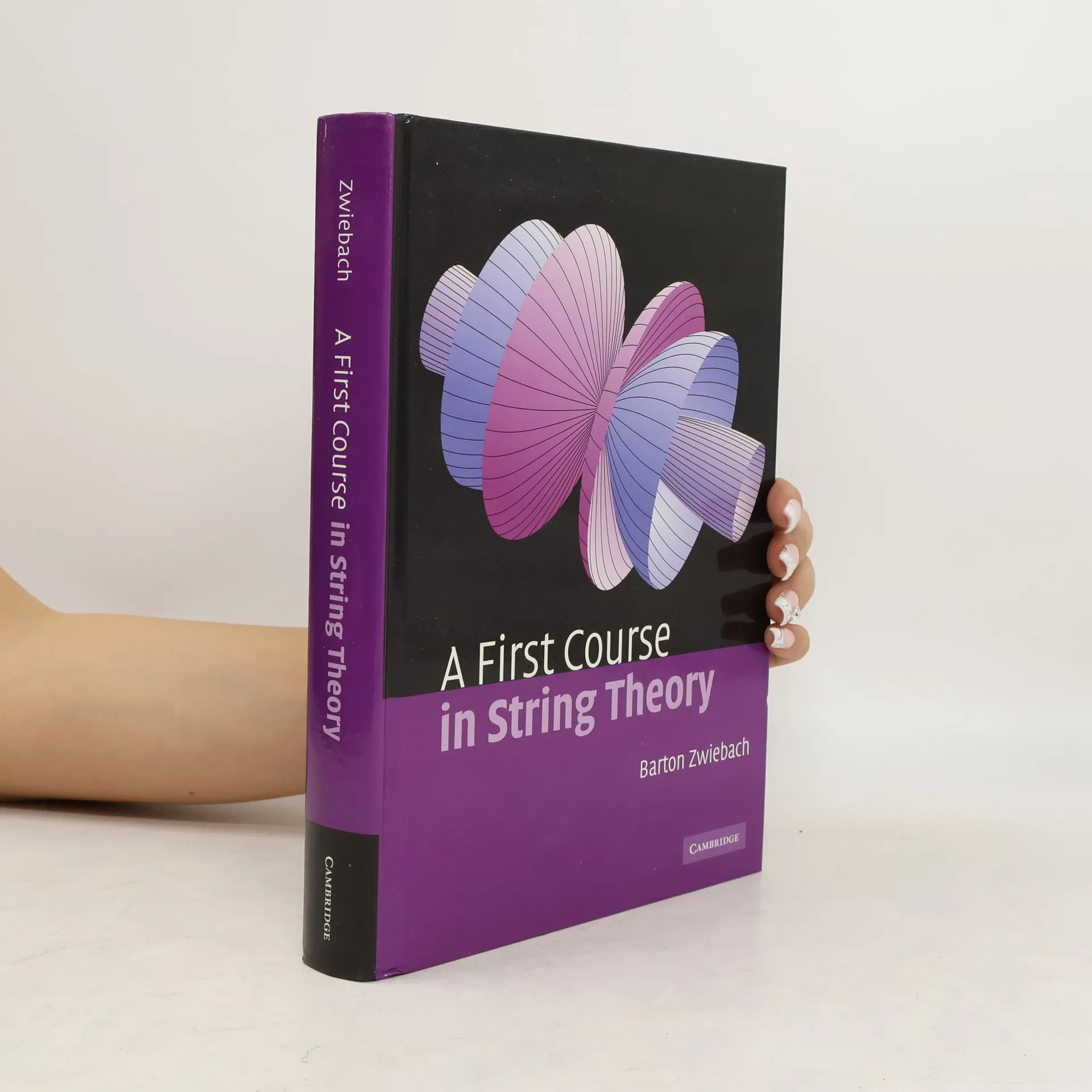
A First Course in String Theory, Barton Zwiebach
- Idioma

- Publicado en
- 2004
- Encuadernación
- (Tapa dura)
Métodos de pago
Nos falta tu reseña aquí
- Título
- A First Course in String Theory
- Idioma
- Inglés
- Autores
- Barton Zwiebach
- Editorial
- Cambridge University Press
- Publicado en
- 2004
- Formato
- Tapa dura
- Páginas
- 558
- ISBN10
- 0521831431
- ISBN13
- 9780521831437
- Serie
- Categorías
- Etiquetas
- Ciencias naturales, Ciencia
- Calificación
- 4,15 de 5
- Descripción
- An accessible introduction to string theory, this book provides a detailed and self-contained demonstration of the main concepts involved. The first part deals with basic ideas, reviewing special relativity and electromagnetism while introducing the concept of extra dimensions. D-branes and the classical dynamics of relativistic strings are discussed next, and the quantization of open and closed bosonic strings in the light-cone gauge, along with a brief introduction to superstrings. The second part begins with a detailed study of D-branes followed by string thermodynamics. It discusses possible physical applications, and covers T-duality of open and closed strings, electromagnetic fields on D-branes, Born/Infeld electrodynamics, covariant string quantization and string interactions. Primarily aimed as a textbook for advanced undergraduate and beginning graduate courses, it will also be ideal for a wide range of scientists and mathematicians who are curious about string theory.