

Más información sobre el libro
James Gow's A Short History of Greek Mathematics (1884) provided the first full account of the subject available in English, and it today remains a clear and thorough guide to early arithmetic and geometry. Beginning with the origins of the numerical system and proceeding through the theorems of Pythagoras, Euclid, Archimedes and many others, the Short History offers in-depth analysis and useful translations of individual texts as well as a broad historical overview of the development of mathematics. Parts I and II concern Greek arithmetic, including the origin of alphabetic numerals and the nomenclature for operations; Part III constitutes a complete history of Greek geometry, from its earliest precursors in Egypt and Babylon through to the innovations of the Ionic, Sophistic, and Academic schools and their followers. Particular attention is given to Pythagorus, Euclid, Archimedes, and Ptolemy, but a host of lesser-known thinkers receive deserved attention as well.
Compra de libros
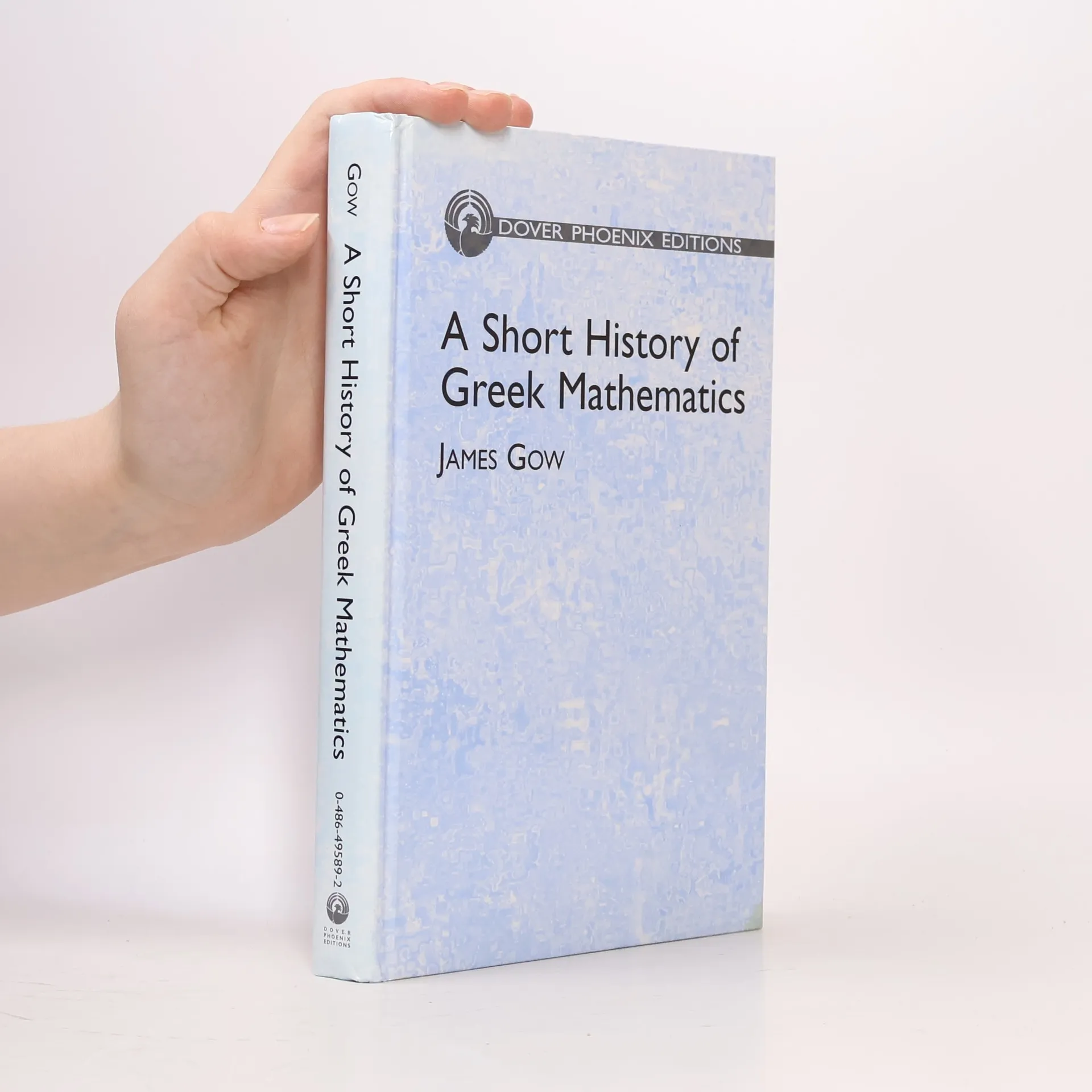
Dover Phoenix Editions: A Short History of Greek Mathematics, James Gow
- Idioma

- Publicado en
- 2004
- Encuadernación
- (Tapa dura)
Métodos de pago
Nadie lo ha calificado todavía.
- Título
- Dover Phoenix Editions: A Short History of Greek Mathematics
- Idioma
- Inglés
- Autores
- James Gow
- Editorial
- Dover Publications
- Publicado en
- 2004
- Formato
- Tapa dura
- Páginas
- 323
- ISBN10
- 0486495892
- ISBN13
- 9780486495897
- Serie
- Etiquetas
- Tema histórico
- Descripción
- James Gow's A Short History of Greek Mathematics (1884) provided the first full account of the subject available in English, and it today remains a clear and thorough guide to early arithmetic and geometry. Beginning with the origins of the numerical system and proceeding through the theorems of Pythagoras, Euclid, Archimedes and many others, the Short History offers in-depth analysis and useful translations of individual texts as well as a broad historical overview of the development of mathematics. Parts I and II concern Greek arithmetic, including the origin of alphabetic numerals and the nomenclature for operations; Part III constitutes a complete history of Greek geometry, from its earliest precursors in Egypt and Babylon through to the innovations of the Ionic, Sophistic, and Academic schools and their followers. Particular attention is given to Pythagorus, Euclid, Archimedes, and Ptolemy, but a host of lesser-known thinkers receive deserved attention as well.