



Parámetros
- 452 páginas
- 16 horas de lectura
Más información sobre el libro
This is a comprehensive textbook for advanced undergraduates and beginning graduate students in physics or astrophysics, developing both the formalism and the physical ideas of special and general relativity in a logical and coherent way. The book is in two parts. Part one focuses on the special theory and begins with the study of relativistic kinematics from three points of view: the physical (the classic gedanken experiments), the algebraic (the Lorentz transformations), and the graphic (the Minkowski diagrams). Part one concludes with chapters on relativistic dynamics and electrodynamics. Part two begins with a chapter introducing differential geometry to set the mathematical background for general relativity. The physical basis for the theory is begun in the chapter on uniform accelerations. Subsequent chapters cover rotation, the electromagnetic field, and material media. A second chapter on differential geometry provides the background for Einstein's gravitational-field equation and Schwarzschild's solution. The physical significance of this solution is examined together with the challenges to the theory that have been successfully met inside the solar system. Other applications follow in the final chapters on astronomy and cosmology: These include black holes, quasars, and gravity waves as well as the relativistic features of an expanding universe including a section on the inflationary model."
Compra de libros
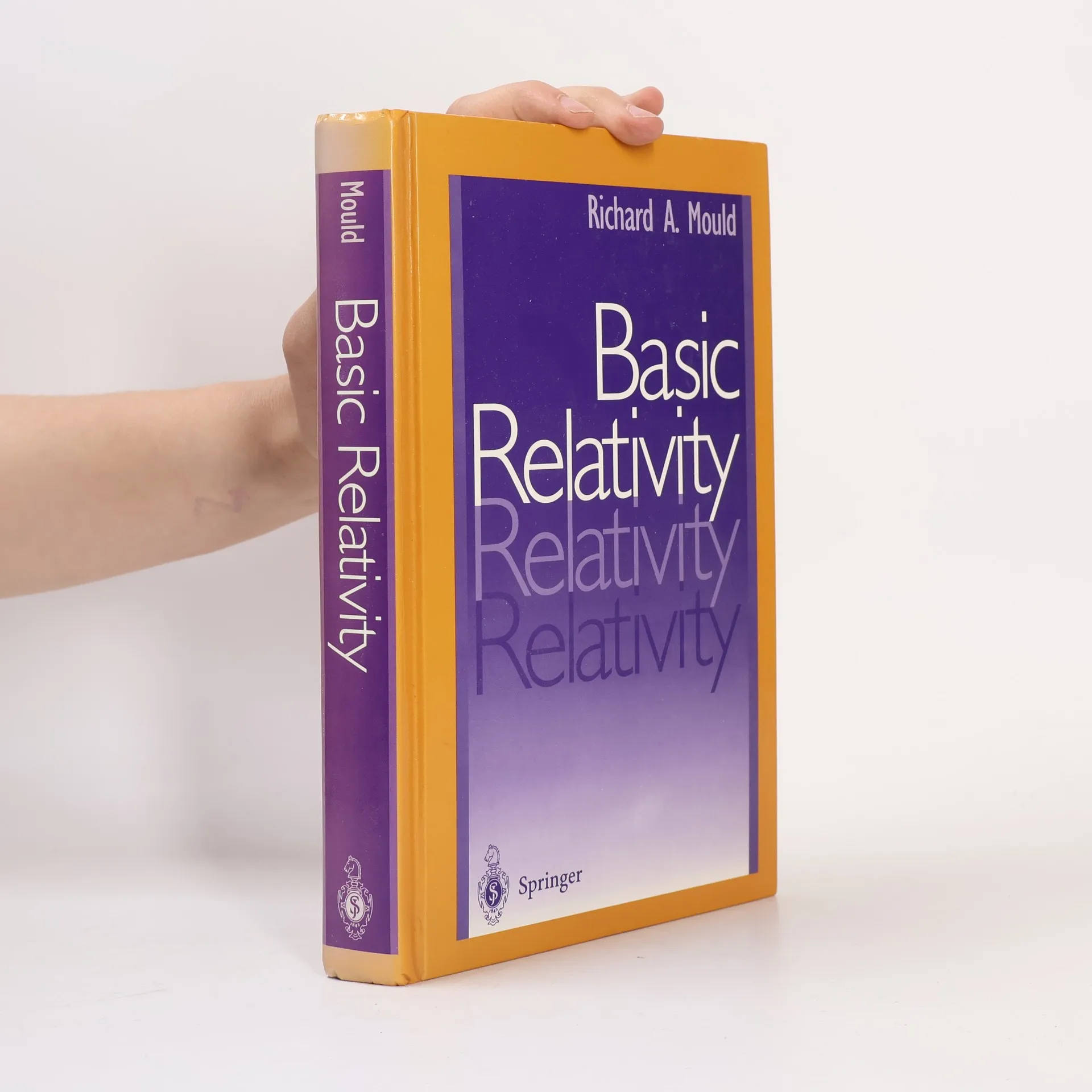
Basic Relativity, Richard A. Mould
- Idioma

- Publicado en
- 1994
- Encuadernación
- (Tapa dura)
Métodos de pago
Nadie lo ha calificado todavía.
- Título
- Basic Relativity
- Idioma
- Inglés
- Autores
- Richard A. Mould
- Editorial
- Springer-Verlag
- Publicado en
- 1994
- Formato
- Tapa dura
- Páginas
- 452
- ISBN10
- 0387941886
- ISBN13
- 9780387941882
- Serie
- Descripción
- This is a comprehensive textbook for advanced undergraduates and beginning graduate students in physics or astrophysics, developing both the formalism and the physical ideas of special and general relativity in a logical and coherent way. The book is in two parts. Part one focuses on the special theory and begins with the study of relativistic kinematics from three points of view: the physical (the classic gedanken experiments), the algebraic (the Lorentz transformations), and the graphic (the Minkowski diagrams). Part one concludes with chapters on relativistic dynamics and electrodynamics. Part two begins with a chapter introducing differential geometry to set the mathematical background for general relativity. The physical basis for the theory is begun in the chapter on uniform accelerations. Subsequent chapters cover rotation, the electromagnetic field, and material media. A second chapter on differential geometry provides the background for Einstein's gravitational-field equation and Schwarzschild's solution. The physical significance of this solution is examined together with the challenges to the theory that have been successfully met inside the solar system. Other applications follow in the final chapters on astronomy and cosmology: These include black holes, quasars, and gravity waves as well as the relativistic features of an expanding universe including a section on the inflationary model."