
"Long after the extinction of dinosaurs, when humans were still in the Stone Age, woolly rhinos, mammoths, mastodons, sabertooth cats, giant ground sloths, and many other spectacular large animals roamed the Earth. In Vanished Giants, paleontologist Anthony J. Stuart explores the lives and environments of these Ice Age animals, moving between six continents and several key islands. Stuart examines the animals themselves via what we've learned from fossil remains, and he describes the landscapes, climates, vegetation, ecological interactions, and other aspects of the animals' existence. Illustrated throughout, Vanished Giants also offers a picture of the world as it was tens of thousands of years ago when these giants still existed -- and, drawing on the latest evidence provided by radiocarbon dating, of how that world may have ended. Linking the extinction of Ice Age megafauna to the beginning of the so-called Sixth Extinction, Vanished Giants has important implications for understanding the likely fate of present-day animals in the face of contemporary climate change and vastly increasing human populations."--Back cover
Anthony S Bryk Libros


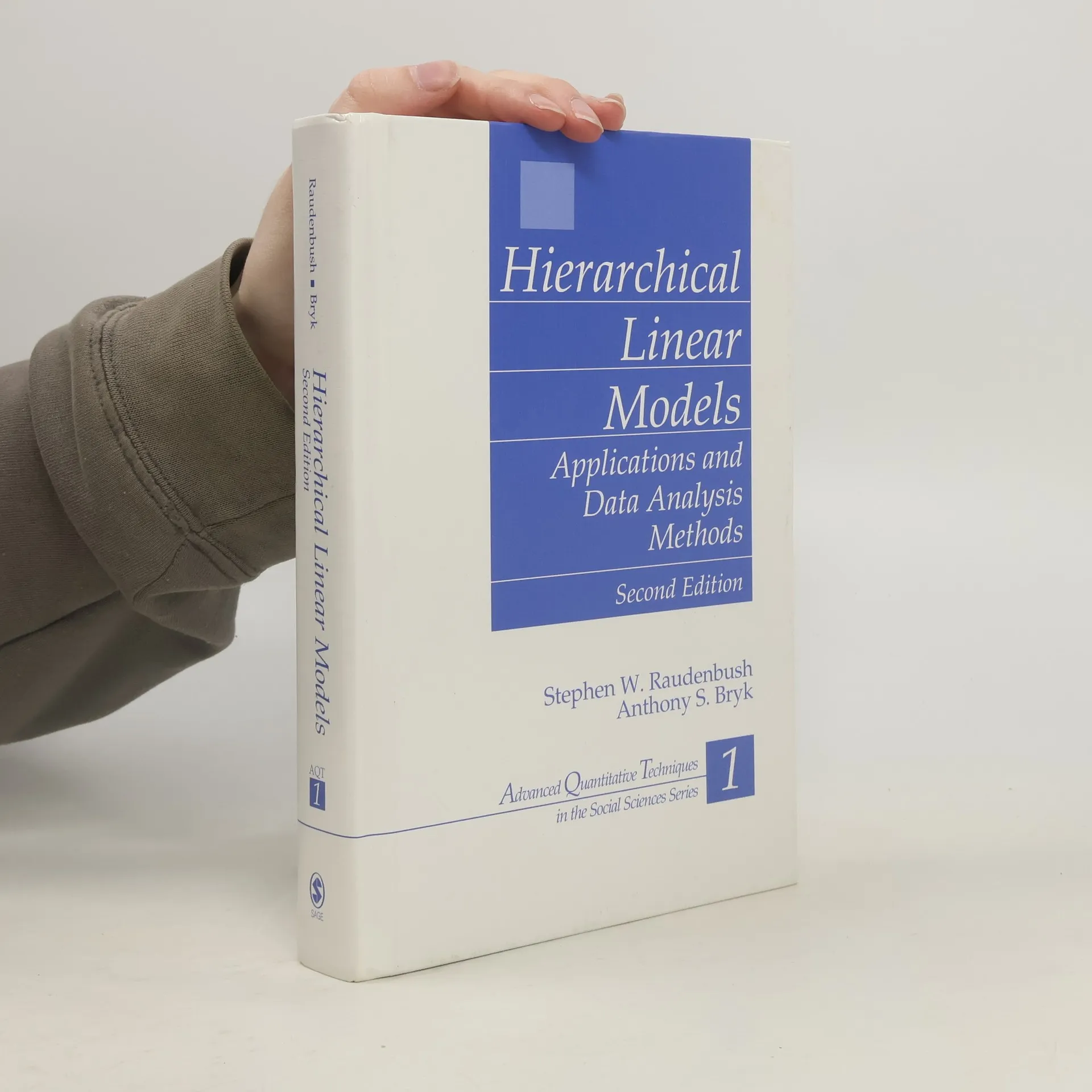
Advanced Quantitative Techniques in the Social Sciences Series - 1: Hierarchical Linear Models
Applications and Data Analysis Methods - Second Edition
- 512 páginas
- 18 horas de lectura
"This is a first-class book dealing with one of the most important areas of current research in applied statistics...the methods described are widely applicable...the standard of exposition is extremely high." --Short Book Reviews from the International Statistical Institute "The new chapters (10-14) improve an already excellent resource for research and instruction. Their content expands the coverage of the book to include models for discrete level-1 outcomes, non-nested level-2 units, incomplete data, and measurement error---all vital topics in contemporary social statistics. In the tradition of the first edition, they are clearly written and make good use of interesting substantive examples to illustrate the methods. Advanced graduate students and social researchers will find the expanded edition immediately useful and pertinent to their research." --TED GERBER, Sociology, University of Arizona "Chapter 11 was also exciting reading and shows the versatility of the mixed model with the EM algorithm. There was a new revelation on practically every page. I found the exposition to be extremely clear. It was like being led from one treasure room to another, and all of the gems are inherently useful. These are problems that researchers face everyday, and this chapter gives us an excellent alternative to how we have traditionally handled these problems."--PAUL SWANK, Houston School of Nursing, University of Texas, Houston Popular in the First Edition for its rich, illustrative examples and lucid explanations of the theory and use of hierarchical linear models (HLM), the book has been reorganized intofour parts with four completely new chapters. The first two parts, Part I on "The Logic of Hierarchical Linear Modeling" and Part II on "Basic Applications" closely parallel the first nine chapters of the previous edition with significant expansions and technical clarifications, such as: * An intuitive introductory summary of the basic procedures for estimation and inference used with HLM models that only requires a minimal level of mathematical sophistication in Chapter 3* New section on multivariate growth models in Chapter 6 * A discussion of research synthesis or meta-analysis applications in Chapter 7* Data analytic advice on centering of level-1 predictors and new material on plausible value intervals and robust standard estimators While the first edition confined its attention to continuously distributed outcomes at level 1, this second edition now includes coverage of an array of outcomes types in Part III: * New Chapter 10 considers applications of hierarchical models in the case of binary outcomes, counted data, ordered categories, and multinomial outcomes using detailed examples to illustrate each case * New Chapter 11 on latent variable models, including estimating regressions from missing data, estimating regressions when predictors are measured with error, and embedding item response models within the framework of the HLM model * New introduction to the logic of Bayesian inference with applications to hierarchical data (Chapter 13) The authors conclude in Part IV with the statistical theory and computations used throughout the book, including univariate models with normal level-1 errors, multivariate linear models, and hierarchical generalized linear models.