The Gaia theory states that on Earth, life interacts with and eventually becomes its own environment. Gaia is a holistic perspective asserting that the Earth is a self-regulating complex system, resonant with the ancient magico-religious understanding that all is one. Innovated by the atmospheric chemist James Lovelock, supported by microbiologist Lynn Margulis and named by novelist William Golding, Gaia states that the temperature and composition of the Earth's atmosphere are actively regulated by the sum of life on the planet, which, seeking a physical and chemical environment optimal for contemporary life, influences the physical attributes of Earth on a planetary scale. In the way that the human mind extends DNA, the atmosphere is an extension of the biosphere: as above, so below. Fusing science, mathematics, philosophy, ecology and mythology, Gaia and Philosophy challenges the anthropocentrism of Western rationalist thought to propose a symbiotic planet. In its striking philosophical conclusion - that the cybernetic control of the Earth's surface by its organisms calls into question the alleged uniqueness of human intelligent consciousness - the revolutionary Gaia paradigm holds important implications not only for understanding life's past but for shaping its future.
Lynn Margulis Orden de los libros
Lynn Margulis fue una científica prominente cuyo trabajo dio forma a nuestra comprensión de la vida en la Tierra. Se adentró en la biología evolutiva, proponiendo ideas revolucionarias sobre el origen y desarrollo de los organismos. Su investigación destacó las relaciones simbióticas como un motor crucial de la evolución. El legado de Margulis reside en sus audaces desafíos a las teorías establecidas y su promoción de una visión holística de la naturaleza.


- 2023
- 2007
Mind, Life, and Universe
Conversations with Great Scientists of Our Time
- 2004
Symbiotická planéta: Nový pohľad na evolúciu
- 168 páginas
- 6 horas de lectura
Kniha významnej americkej biologičky je o planetárnom živote a planetárnej evolúcii, ako aj o zmenách našich názorov na tieto dve oblasti. Ak možno hovoriť, že má aj istý podtext, tak je to výskum, konkrétne vedecký výskum, a množstvo zvratov a metód konania, ktoré ho môžu podporovať, alebo naopak, brzdiť.
- 2000
Half a century ago the Austrian physicist and philosopher Erwin Schrodinger inspired a generation of scientists by rephrasing the philosophical question: What is life?. This text revisits this question in a narrative which combines rigorous science with philosophy, history and poetry. schovat popis
- 1999
Symbiotic Planet: A New Look at Evolution
- 160 páginas
- 6 horas de lectura
Named ”best biology book of the year” by Library Journal, Symbiotic Planet describes how symbiosis is the key to understanding the origins of cells, the evolution of sex, the emergence of life on land, and even the physiology of our planet.
- 1993
- 1988
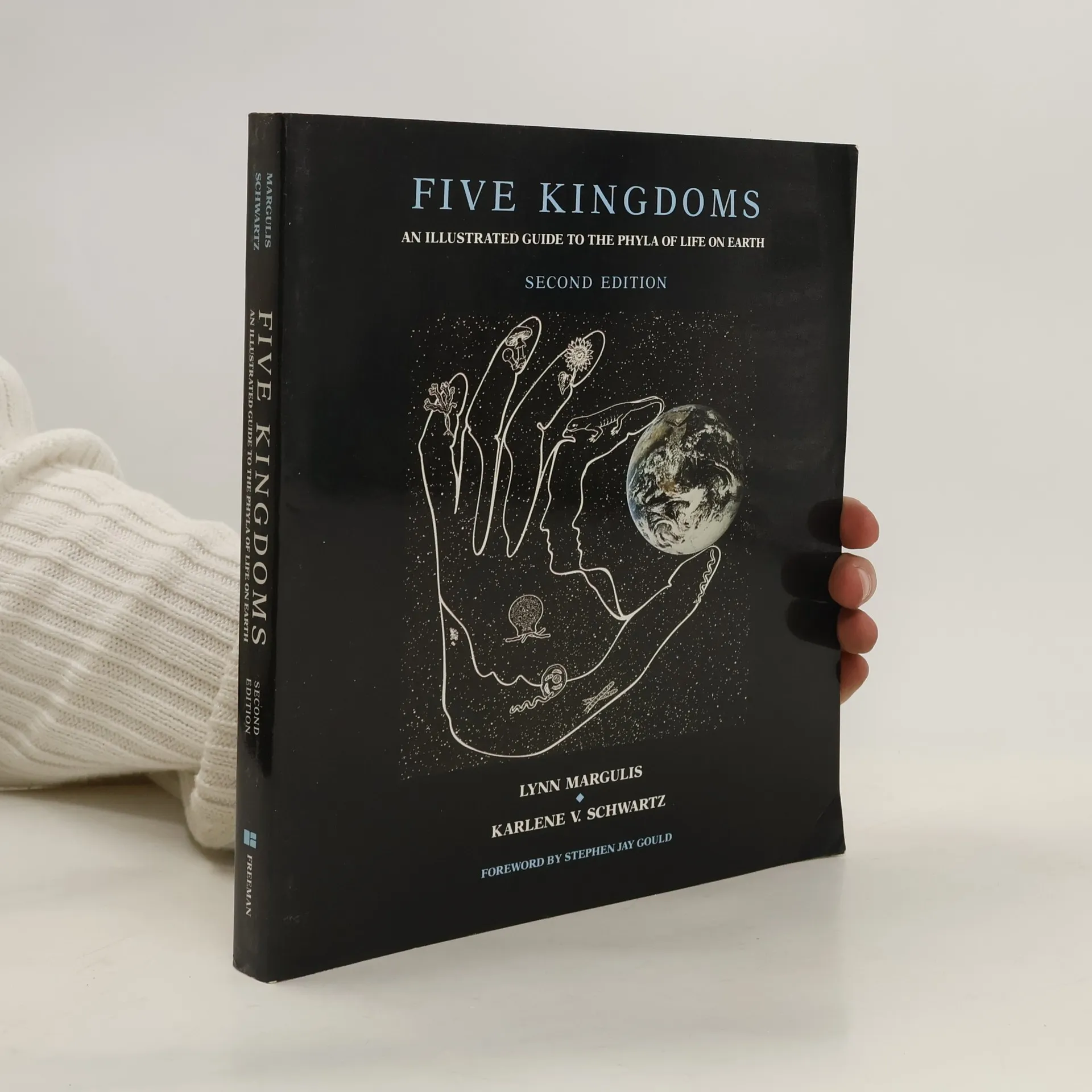
Five Kingdoms
- 376 páginas
- 14 horas de lectura
Offers an illustrated reference to both microbes and macroscopic organisms. Brief essays introduce broad outlines of kingdoms and phyla. Entries on specific organisms give information on appearance, environment, relations to other organisms, and how scientists group them, and include bandw photos and diagrams. An introduction explains classification systems. Includes lists of museums, geological sites, and Web sites, plus a glossary and lists of phyla and genera assigned to phyla. Six sets of 35-mm color transparencies are available. Useful for students of biology at any level. Annotation copyrighted by Book News, Inc., Portland, OR