

John Gerring es Profesor de Ciencias Políticas en la Universidad de Boston. Su investigación se centra en las instituciones políticas y las metodologías de la ciencia política, buscando comprender cómo los arreglos institucionales influyen en los resultados políticos. Se esfuerza por superar las limitaciones de los enfoques tradicionales de la política comparada a través de herramientas metodológicas innovadoras.
Preface; Part I. Case Studies: 1. Surveys; 2. Definitions; Part II. Selecting
Cases: 3. Overview of case selection; 4. Descriptive case studies; 5. Causal
case studies; 6. Algorithms and samples; Part III. Analyzing Cases: 7. A
typology of research designs; 8. Quantitative and qualitative modes of
analysis; Part IV. Validity: 9. Internal validity; 10. External validity; Part
V. Conclusions: 11. Tradeoffs; Part VI. References; Index.
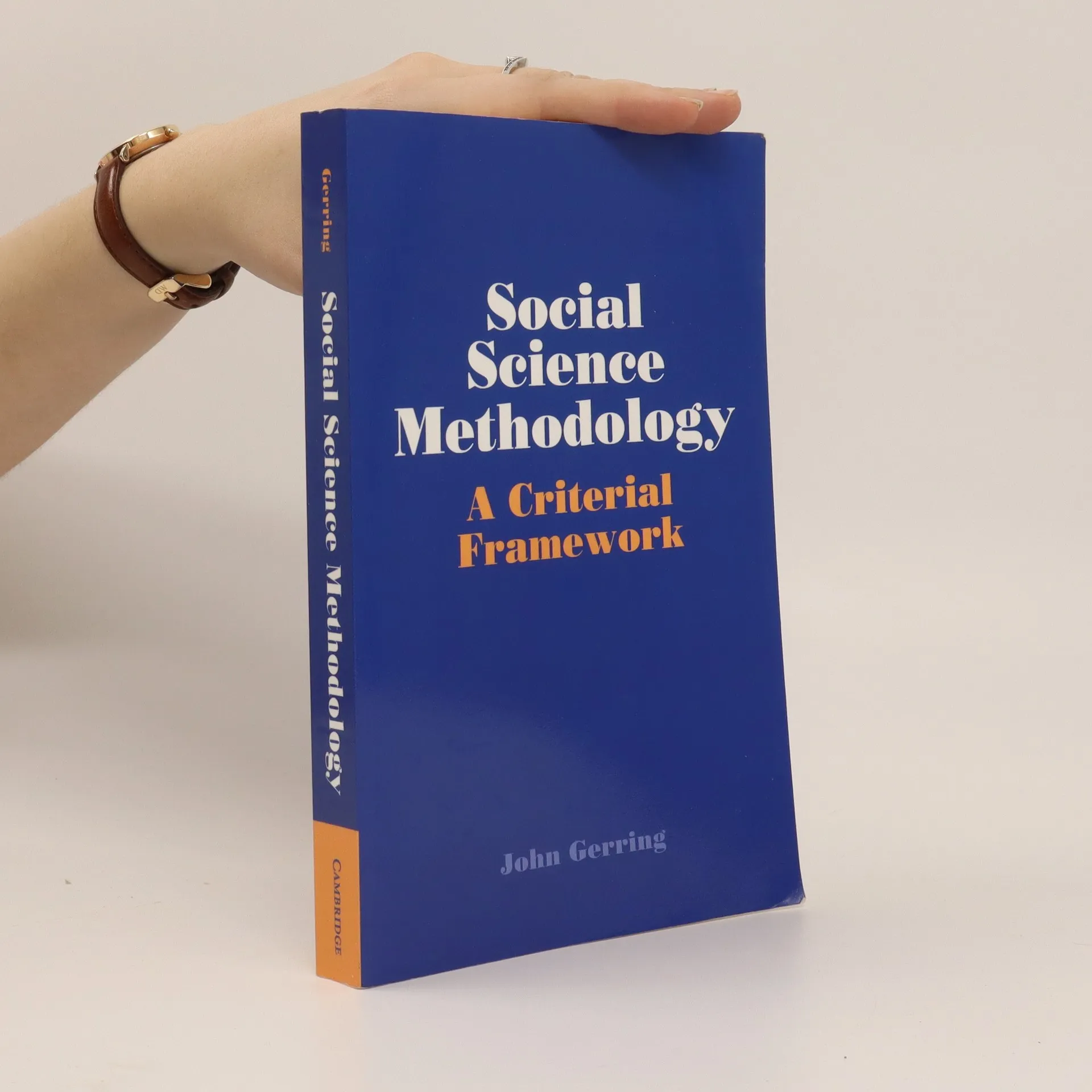
This book is an introduction to methodological issues in the social sciences that is appropriate for advanced undergraduates, graduate students, and general readers with some background in social science subjects. It is a concise and readable guide to doing and evaluating work in anthropology, economics, history, political science, psychology, and sociology.
While population affects nearly every aspect of politics, its impact has been
strikingly under-researched. This book rectifies this omission by examining
scale effects across a great variety of political dimensions, encompassing all
levels of politics. The authors provide generalizable findings alongside
detailed analyses of specific cases.
A practical guide to finding your research topic, for social scientists of all
fields who wish to improve their creativity and productivity. It should be of
interest to readers who are just setting out and looking for thesis topics, as
well as those who have been ploughing the fields for some time and wish to
explore new areas.
This book explores the deep roots of modern democracy, focusing on geography
and long-term patterns of global diffusion, through statistical analyses of
new databases, small-N studies and a review of the historical literature. It
will appeal to historically-oriented social scientists, political historians,
and anyone interested in democracy.
This textbook provides a clear, concise, and comprehensive introduction to methodological issues encountered by the various social science disciplines. It emphasizes applications, with detailed examples, so that readers can put these methods to work in their research. Within a unified framework, John Gerring and Dino Christenson integrate a variety of methods - descriptive and causal, observational and experimental, qualitative and quantitative. The text covers a wide range of topics including research design, data-gathering techniques, statistics, theoretical frameworks, and social science writing. It is designed both for those attempting to make sense of social science, as well as those aiming to conduct original research. The text is accompanied by online practice questions, exercises, examples, and additional resources, including related readings and websites. An essential resource for undergraduate and postgraduate programs in communications, criminal justice, economics, business, finance, management, education, environmental policy, international development, law, political science, public health, public policy, social work, sociology, and urban planning.