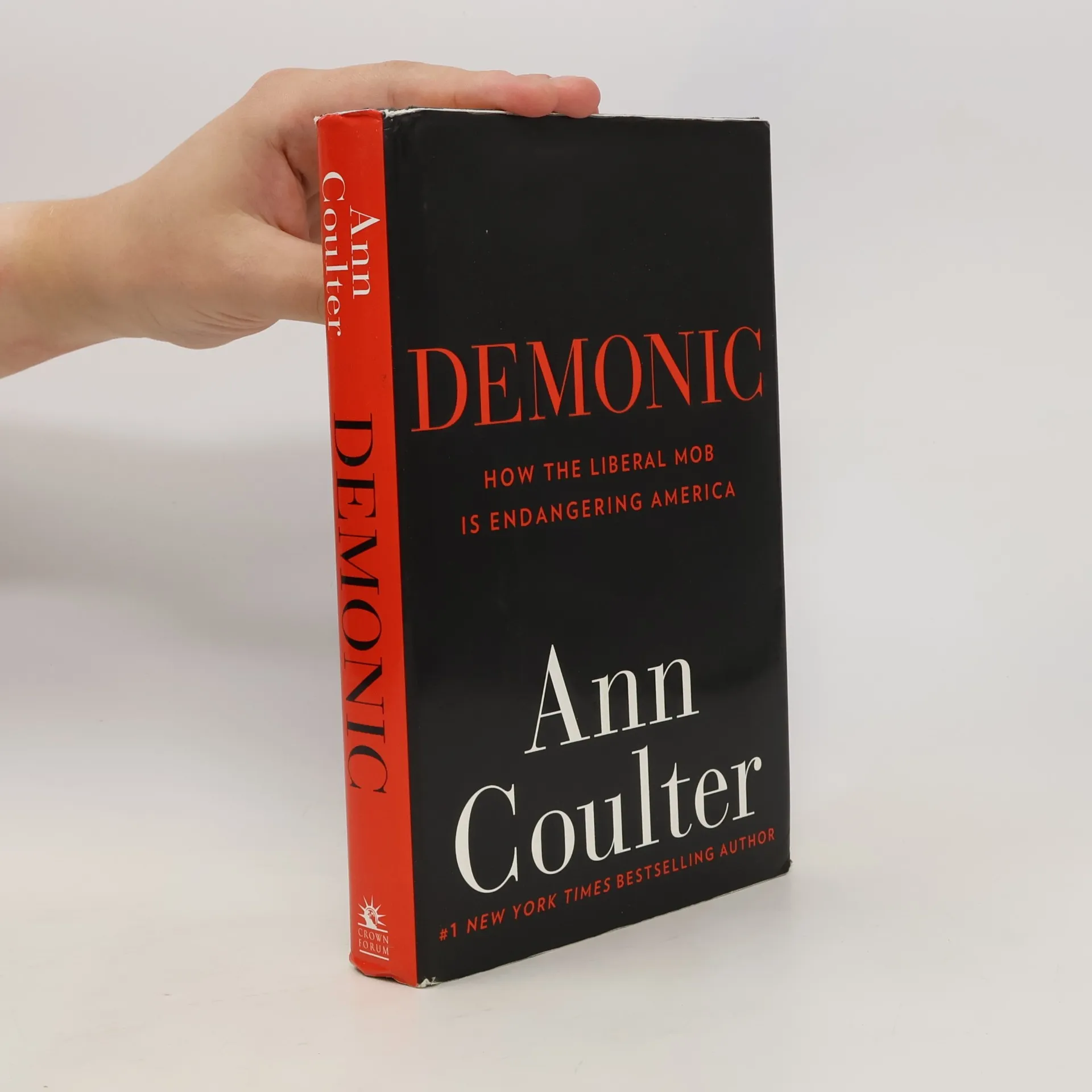
Ann Coulter es reconocida por sus comentarios provocadores e influyentes sobre política y sociedad. Su escritura se caracteriza por un intelecto agudo y un estilo intransigente que confronta sin miedo los puntos de vista predominantes. Coulter profundiza en el análisis de cuestiones sociales y políticas, haciendo hincapié en la defensa de las libertades individuales y los valores tradicionales. Sus obras a menudo se convierten en objeto de debates apasionados, provocando fuertes reacciones en los lectores.
The conservative columnist shares her thoughts on everything from political correctness and foreign policy to the media, Hollywood celebrities, and the French, in a collection of her no-holds-barred commentary, accompanied by never-before-published responses from readers on both sides of the political spectrum. 400,000 first printing.
The immutable fact of politics in America is this: liberals hate conservatives. Ann Coulter, known for her bestselling examination of the Clinton impeachment, tackles an even tougher issue. Despite the potential for congeniality between Democrats and Republicans, political debate has become increasingly hostile and trivial. Whether in Congress or on talk shows, politics has devolved into a nasty sport. At the heart of this issue, Coulter argues, is the behavior of liberals, who engage in cultlike conduct and vicious attacks on Republicans while controlling mainstream media narratives. They portray conservatives as dumb, racist, and homophobic, disregarding the significant Republican achievements of recent decades and the Bush administration's adept handling of national crises. Through incisive reasoning and meticulous research, Coulter explores the events and personalities that have shaped modern political discourse, highlighting the bickering and name-calling that inflate partisan disputes. She critiques the media's bias, which often vilifies the right while praising the left, suggesting that if conservatives had dominated media for years, they might have lost the ability to debate constructively. In this environment, the public square is saturated with liberal propaganda. Refreshingly honest and timely, this work continues the conversation on media bias and political discourse.
<b>The demon is a mob, and the mob is demonic. The Democratic Party activates mobs, depends on mobs, coddles mobs, publicizes and celebrates mobs—it is the mob. Sweeping in its scope and relentless in its argument, <i>Demonic </i>explains the peculiarities of liberals as standard groupthink behavior. To understand mobs is to understand liberals.</b> In her most provocative book to date, Ann Coulter argues that liberals exhibit all the psychological characteristics of a mob, for instance: <b>Liberal Groupthink: </b>“The same mob mentality that leads otherwise law-abiding people to hurl rocks at cops also leads otherwise intelligent people to refuse to believe anything they haven’t heard on NPR.” <b>Liberal Schemes: </b>“No matter how mad the plan is—Fraternité, the ‘New Soviet Man,’ the Master Race, the Great Leap Forward, the Cultural Revolution, Building a New Society, ObamaCare—a mob will believe it.” <b>Liberal Enemies: </b>“Instead of ‘counterrevolutionaries,’ liberals’ opponents are called ‘haters,’ ‘those who seek to divide us,’ ‘tea baggers,’ and ‘right-wing hate groups.’ Meanwhile, conservatives call liberals ‘liberals’—and that makes them testy.” <b>Liberal Justice: </b>“In the world of the liberal, as in the world of Robespierre, there are no crimes, only criminals.” <b>Liberal Violence: </b>“If Charles Manson’s followers hadn’t killed Roman Polanski’s wife, Sharon Tate, Clinton would have pardoned him, too, and he’d probably be teaching at Northwestern University.” Citing the father of mob psychology, Gustave Le Bon, Coulter catalogs the Left’s mob behaviors: the creation of messiahs, the fear of scientific innovation, the mythmaking, the preference for images over words, the lack of morals, and the casual embrace of contradictory ideas. Coulter traces the history of the liberal mob to the French Revolution and Robespierre’s revolutionaries (delineating a clear distinction from America’s founding fathers), who simply proclaimed that they were exercising the “general will” before slaughtering their fellow citizens “for the good of mankind.” Similarly, as Coulter demonstrates, liberal mobs, from student radicals to white-trash racists to anti-war and pro-ObamaCare fanatics today, have consistently used violence to implement their idea of the “general will.” This is not the American tradition; it is the tradition of Stalin, of Hitler, of the guillotine—and the tradition of the American Left. As the heirs of the French Revolution, Democrats have a history that consists of pandering to mobs, time and again, while Republicans, heirs to the American Revolution, have regularly stood for peaceable order. Hoping to muddy this horrifying truth, liberals slanderously accuse conservatives of their own crimes—assassination plots, conspiracy theorizing, political violence, embrace of the Ku Klux Klan. Coulter shows that the truth is the opposite: Political violence—mob violence—is always a Democratic affair. Surveying two centuries of mob movements, Coulter demonstrates that the mob is always destructive. And yet, she argues, beginning with the civil rights movement in the sixties, Americans have lost their natural, inherited aversion to mobs. Indeed, most Americans have no idea what they are even dealing with. Only by recognizing the mobs and their demonic nature can America begin to defend itself.