

In a world of mutually exclusive nation-states, international migration constitutes a fundamental anomaly. No wonder that such states have been inclined to select migrants according to their origins. The result is ethnic migration.But Christian Joppke shows that after World War II there has been a trend away from ethnic selectivity and toward non-discriminatory immigration policies across Western states. Indeed, he depicts the modern state in the crossfire of particularistic and universalistic principles and commitments, with universalism gradually winning the upper hand. Thus, the policies that regulate the boundaries of states can no longer invoke the particularisms that constitute these boundaries and the collectivities residing within them.Joppke presents detailed case studies of the United States, Australia, Western Europe, and Israel. His book will be of interest to a broad audience of sociologists, political scientists, historians, legal scholars, and area specialists.
Christian Joppke Libros

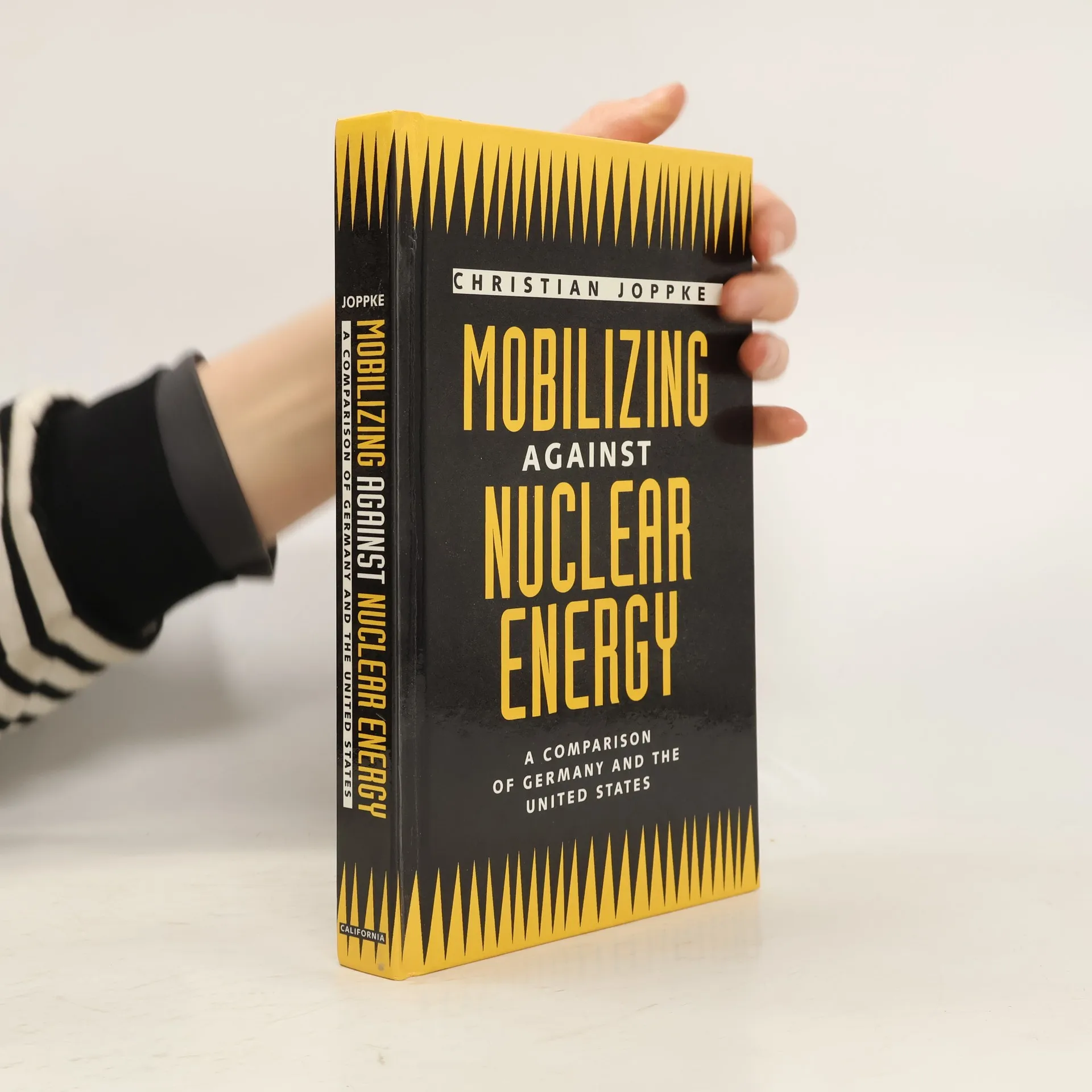

Mobilizing Against Nuclear Energy
A Comparison of Germany and the United States
- 307 páginas
- 11 horas de lectura
In the past two decades young people, environmentalists, church activists, leftists, and others have mobilized against nuclear energy. Anti-nuclear protest has been especially widespread and vocal in Western Europe and the United States. In this lucid, richly documented book, Christian Joppke compares the rise and fall of these protest movements in Germany and the United States, illuminating the relationship between national political structures and collective action. He analyzes existing approaches to the study of social movements and suggests an insightful new paradigm for research in this area. Joppke proposes a political process perspective that focuses on the interrelationship between the state and social movements, a model that takes into account a variety of forces, including differential state structures, political cultures, movement organizations, and temporal and contextual factors. This is an invaluable work for anyone studying the dynamics of social movements around the world.
Der säkulare Staat auf dem Prüfstand
Religion und Politik in Europa und den USA
- 350 páginas
- 13 horas de lectura
Die muslimische Migration in Europa und der wachsende Einfluss der »Christlichen Rechten« in den USA stellen parallele Herausforderungen für den säkularen Staat auf beiden Seiten des Nordatlantiks dar, so der Befund des Soziologen Christian Joppke. Wie kann der Staat sich von Religion freihalten, ohne das Recht auf Religionsfreiheit anzutasten – insbesondere, wenn Religion gegen die Grundsätze des liberalen Staates verstößt, wie etwa gegen Menschenrechte und Gleichbehandlung? In seiner aufschlussreichen und provokativen Studie beschreibt der Autor sowohl auf politischer wie rechtlicher Ebene die Probleme, die sich westlichen säkularen Staaten durch das Comeback von »öffentlicher Religion« stellen.