



Parámetros
Más información sobre el libro
This book explains in simple settings the fundamental ideas of financial market modelling and derivative pricing, using the no-arbitrage principle. Relatively elementary mathematics leads to powerful notions and techniques - such as viability, completeness, self-financing and replicating strategies, arbitrage and equivalent martingale measures - which are directly applicable in practice. The general methods are applied in detail to pricing and hedging European and American options within the Cox-Ross-Rubinstein (CRR) binomial tree model. A simple approach to discrete interest rate models is included, which, though elementary, has some novel features. All proofs are written in a user-friendly manner, with each step carefully explained and following a natural flow of thought. In this way the student learns how to tackle new problems.
Compra de libros
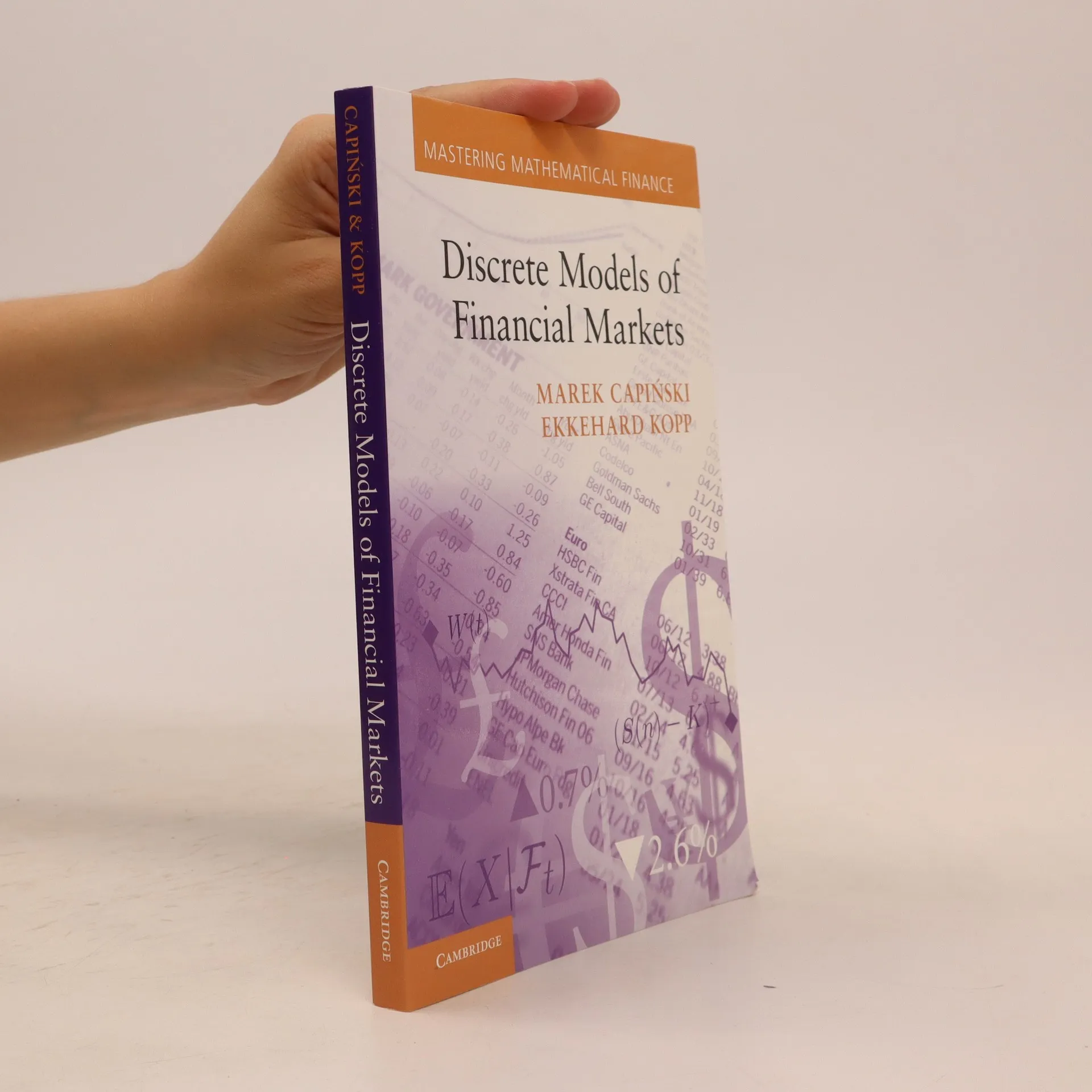
Discrete models of financial markets, Marek Capiński, Ekkehard Kopp
- Idioma

- Publicado en
- 2012
- Encuadernación
- (Tapa blanda)
Métodos de pago
Nos falta tu reseña aquí
- Título
- Discrete models of financial markets
- Idioma
- Inglés
- Autores
- Marek Capiński, Ekkehard Kopp
- Editorial
- Cambridge University Press
- Publicado en
- 2012
- Formato
- Tapa blanda
- ISBN10
- 0521175720
- ISBN13
- 9780521175722
- Etiquetas
- Calificación
- 4,75 de 5
- Descripción
- This book explains in simple settings the fundamental ideas of financial market modelling and derivative pricing, using the no-arbitrage principle. Relatively elementary mathematics leads to powerful notions and techniques - such as viability, completeness, self-financing and replicating strategies, arbitrage and equivalent martingale measures - which are directly applicable in practice. The general methods are applied in detail to pricing and hedging European and American options within the Cox-Ross-Rubinstein (CRR) binomial tree model. A simple approach to discrete interest rate models is included, which, though elementary, has some novel features. All proofs are written in a user-friendly manner, with each step carefully explained and following a natural flow of thought. In this way the student learns how to tackle new problems.