



Más información sobre el libro
Game theoretic reasoning is central to economic theory and widely applied in social and behavioral sciences. This book presents the core principles of game theory, illustrating their relevance to economic, social, political, and biological phenomena. It emphasizes understanding the main ideas behind the theory rather than focusing solely on mathematical expressions. Concepts are clearly defined, and logical reasoning is consistently applied. While a basic understanding of mathematics is necessary, no prior knowledge of economics, political science, or related fields is required. The content covers essential concepts such as strategic games, extensive games with perfect information, and coalitional games, as well as advanced topics like Bayesian games and extensive games with imperfect information. Additional subjects include repeated games, bargaining theory, evolutionary equilibrium, rationalizability, and maxminimization. The book features a diverse range of illustrations from various social and behavioral sciences, accompanied by over 280 exercises. Each topic is supported by examples that clarify theoretical points and demonstrate practical applications of the theory. By explaining key concepts of game theory in a straightforward manner while ensuring precision, this text is well-suited for undergraduate and introductory graduate courses in the field.


Compra de libros
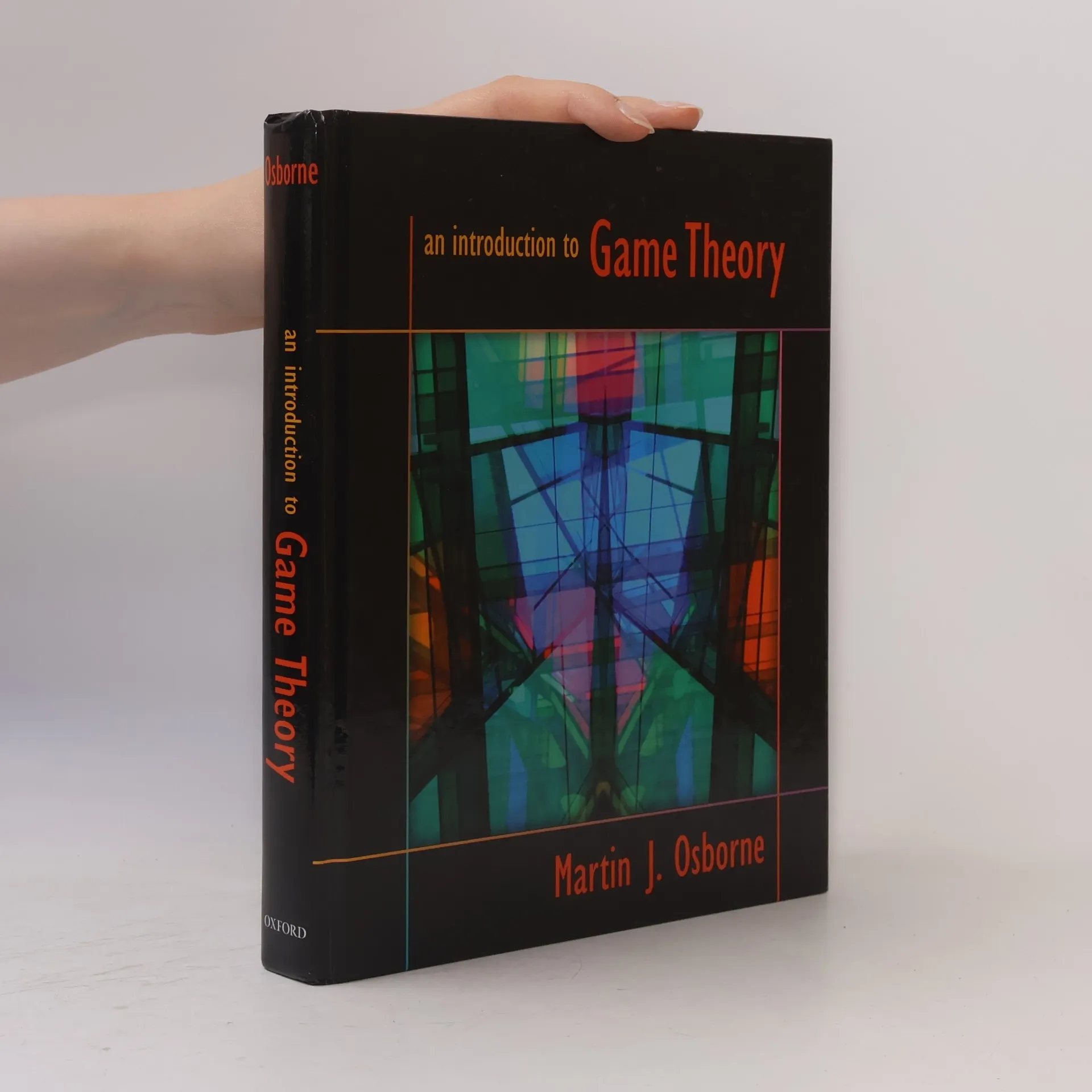
An Introduction to Game Theory, Martin J. Osborne
- Idioma

- Publicado en
- 2004
- product-detail.submit-box.info.binding
- (Tapa dura),
- Estado del libro
- Muy Bueno
- Precio
- 29,99 €
Métodos de pago
Nos falta tu reseña aquí
- Idioma
- Inglés
- Autores
- Martin J. Osborne
- Editorial
- Oxford University Press
- Publicado en
- 2004
- Formato
- Tapa dura
- Páginas
- 560
- ISBN10
- 0195128958
- ISBN13
- 9780195128956
- Serie
- Etiquetas
- No ficción, Libros de texto, Comercio, Negocios & Gestión, Guías y Manuales, Ciencia, Economía, Libros de texto de matemáticas
- Calificación
- 3,8 de 5
- Descripción
- Game theoretic reasoning is central to economic theory and widely applied in social and behavioral sciences. This book presents the core principles of game theory, illustrating their relevance to economic, social, political, and biological phenomena. It emphasizes understanding the main ideas behind the theory rather than focusing solely on mathematical expressions. Concepts are clearly defined, and logical reasoning is consistently applied. While a basic understanding of mathematics is necessary, no prior knowledge of economics, political science, or related fields is required. The content covers essential concepts such as strategic games, extensive games with perfect information, and coalitional games, as well as advanced topics like Bayesian games and extensive games with imperfect information. Additional subjects include repeated games, bargaining theory, evolutionary equilibrium, rationalizability, and maxminimization. The book features a diverse range of illustrations from various social and behavioral sciences, accompanied by over 280 exercises. Each topic is supported by examples that clarify theoretical points and demonstrate practical applications of the theory. By explaining key concepts of game theory in a straightforward manner while ensuring precision, this text is well-suited for undergraduate and introductory graduate courses in the field.