



Más información sobre el libro
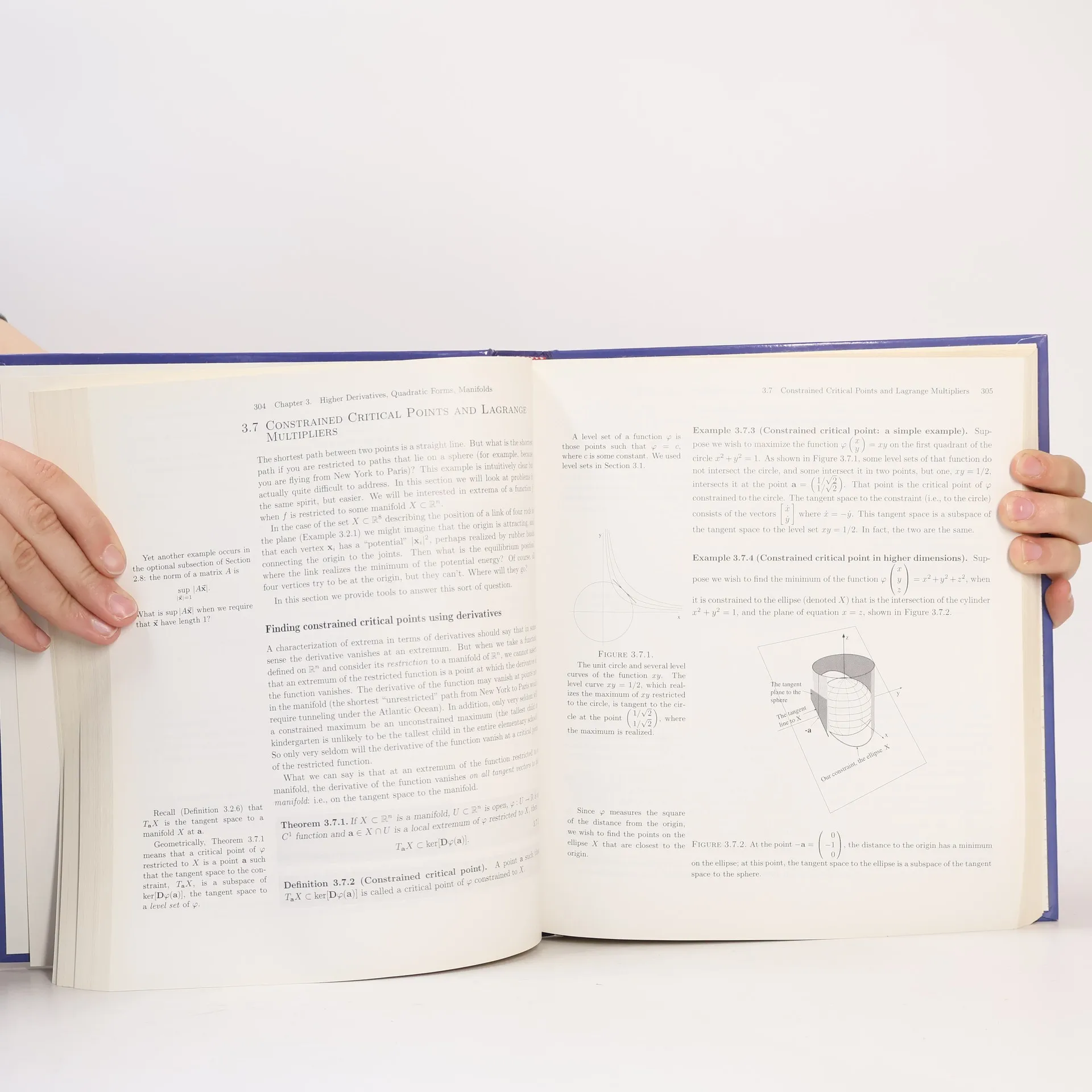
This text covers most of the standard topics in multivariate calculus and part of a standard first course in linear algebra. It focuses on underlying ideas, integrates theory and applications, offers a host of pedagogical aids, and features coverage of differential forms and an emphasis on numerical methods to prepare students for modern applications of mathematics. *Covers important material that is usually omitted. *Presents more difficult and longer proofs (e.g. Proofs of the Kantorovitch theorem, the implicit function theorem) in an appendix. *Makes a careful distinction between vectors and points. *Features an innovative approach to the implicit function theorem and inverse function theorem using Newton's method. *Always emphasizes the underlying meaning - what is really going on (generally, with a geometric interpretation) - eg. The chain rule is a composition of linear transformations; the point of the implicit function theorem is to guarantee that under certain circumstances, non-linear equations have solutions. *Integrates theory and applications. *Begins most chapters with a treatment of a linear problem and then shows how the 7 methods apply to corresponding non-linear p


Compra de libros
Vector Calculus, Linear Algebra and Differential Forms, John H. Hubbard, Barbara Burke Hubbard
- Idioma

- Publicado en
- 1998
- Encuadernación
- (Tapa dura)
Métodos de pago
Nos falta tu reseña aquí
- Subtítulo
- A Unified Approach
- Idioma
- Inglés
- Autores
- John H. Hubbard, Barbara Burke Hubbard
- Editorial
- Pearson College Div
- Publicado en
- 1998
- Formato
- Tapa dura
- Páginas
- 687
- ISBN10
- 0136574467
- ISBN13
- 9780136574460
- Serie
- Etiquetas
- No ficción, Libros de texto, Ciencia y Matemáticas, Ciencia, Matemáticas, Tecnología, Inteligencia Artificial
- Calificación
- 5 de 5
- Descripción
- This text covers most of the standard topics in multivariate calculus and part of a standard first course in linear algebra. It focuses on underlying ideas, integrates theory and applications, offers a host of pedagogical aids, and features coverage of differential forms and an emphasis on numerical methods to prepare students for modern applications of mathematics. *Covers important material that is usually omitted. *Presents more difficult and longer proofs (e.g. Proofs of the Kantorovitch theorem, the implicit function theorem) in an appendix. *Makes a careful distinction between vectors and points. *Features an innovative approach to the implicit function theorem and inverse function theorem using Newton's method. *Always emphasizes the underlying meaning - what is really going on (generally, with a geometric interpretation) - eg. The chain rule is a composition of linear transformations; the point of the implicit function theorem is to guarantee that under certain circumstances, non-linear equations have solutions. *Integrates theory and applications. *Begins most chapters with a treatment of a linear problem and then shows how the 7 methods apply to corresponding non-linear p