


Más información sobre el libro
Traditional courses on differential equations emphasize solution techniques, but most equations, especially nonlinear ones in higher dimensions, lack elementary solutions. A century ago, Poincaré revolutionized the field with his insights on the three-body problem, proposing that differential equations define families of parametric curves in higher dimensions, shifting the focus to understanding their geometry and behavior. The first part of this series addresses differential equations in one dimension, where geometric complications are limited, and aims to extend these methods to higher dimensions. This transition presents greater challenges, with some chapters being more advanced than Part I, yet still accessible to undergraduates. Poincaré's groundbreaking ideas took time for the mathematical community to fully appreciate, and prior to computer graphics, the notion of teaching this material at the undergraduate level seemed implausible. However, advancements now allow us to incorporate Poincaré's approach into the curriculum, enabling experimental exploration of these concepts. The companion software, MacMath, along with its extensions, is designed to animate these ideas, enhancing the learning experience.
Compra de libros
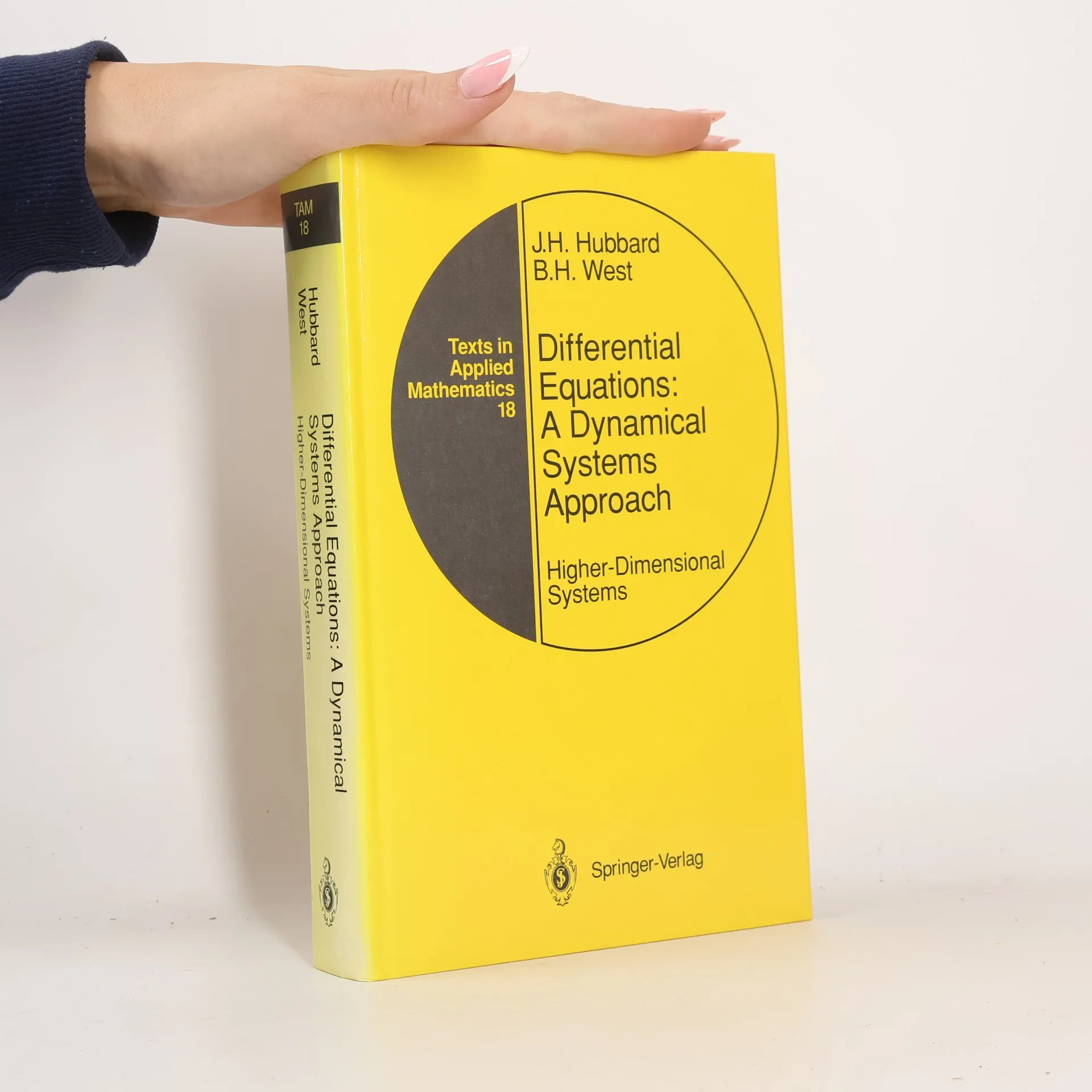
Differential Equations: A Dynamical Systems Approach 18, John H. Hubbard, Beverly H. West
- Idioma

- Publicado en
- Encuadernación
- (Tapa dura)
Métodos de pago
Nadie lo ha calificado todavía.
- Título
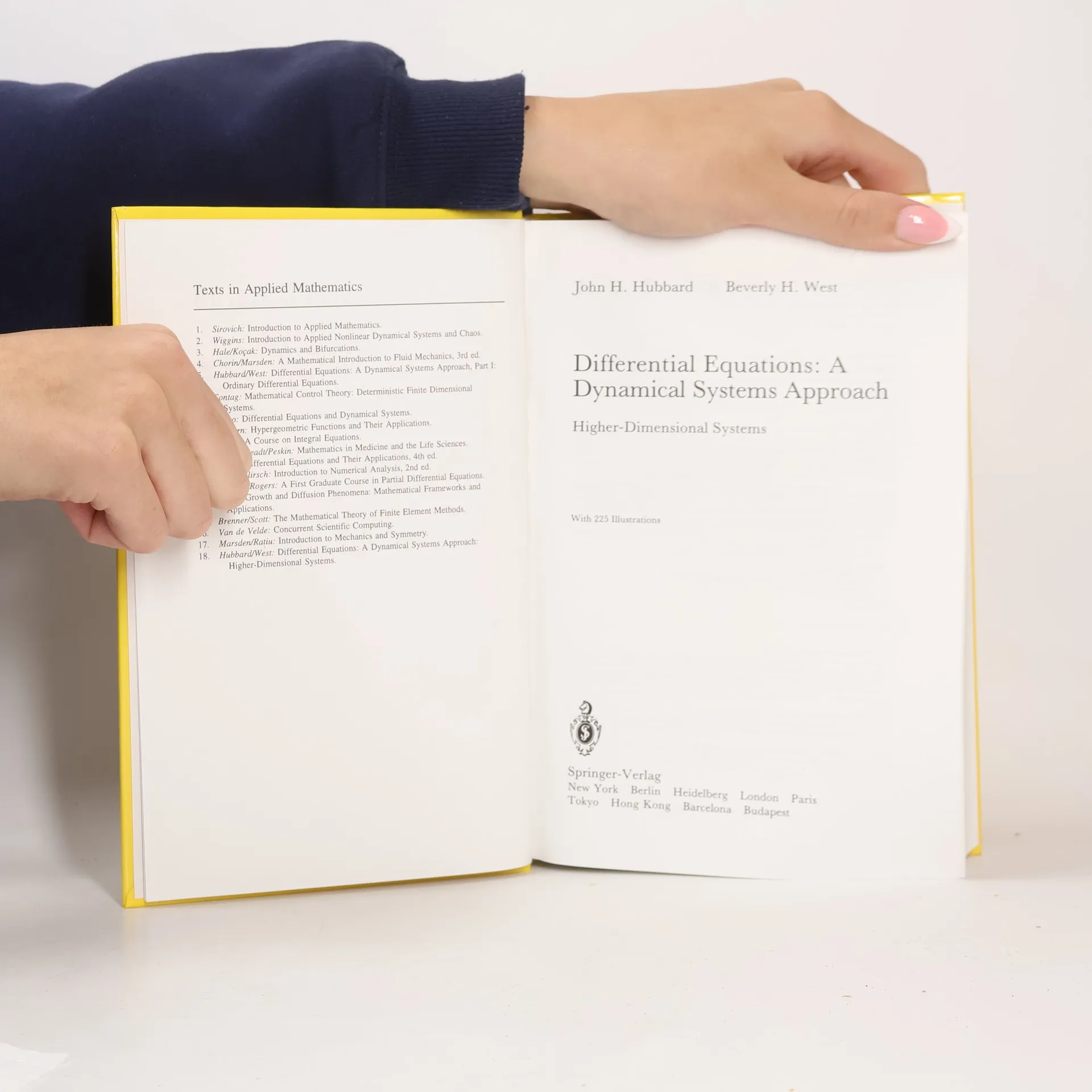
- Differential Equations: A Dynamical Systems Approach 18
- Subtítulo
- Higher-Dimensional Systems
- Idioma
- Inglés
- Autores
- John H. Hubbard, Beverly H. West
- Editorial
- Springer-Verlag
- Formato
- Tapa dura
- ISBN10
- 0387943773
- ISBN13
- 9780387943770
- Serie
- Categorías
- Etiquetas
- Libros de texto
- Descripción
- Traditional courses on differential equations emphasize solution techniques, but most equations, especially nonlinear ones in higher dimensions, lack elementary solutions. A century ago, Poincaré revolutionized the field with his insights on the three-body problem, proposing that differential equations define families of parametric curves in higher dimensions, shifting the focus to understanding their geometry and behavior. The first part of this series addresses differential equations in one dimension, where geometric complications are limited, and aims to extend these methods to higher dimensions. This transition presents greater challenges, with some chapters being more advanced than Part I, yet still accessible to undergraduates. Poincaré's groundbreaking ideas took time for the mathematical community to fully appreciate, and prior to computer graphics, the notion of teaching this material at the undergraduate level seemed implausible. However, advancements now allow us to incorporate Poincaré's approach into the curriculum, enabling experimental exploration of these concepts. The companion software, MacMath, along with its extensions, is designed to animate these ideas, enhancing the learning experience.