




Parámetros
- 661 páginas
- 24 horas de lectura
Más información sobre el libro
This book uncovers new material about the ancient Christian work known as the Physiologus, providing insights into its multilingual transmission and reception. It features ten chapters and new editions of sample texts, focusing on the oldest Greek recension and its early translations into Latin, Armenian, Syriac, Coptic, Ethiopic, Georgian, Arabic, and Old Slavonic. Produced by specialists, it serves as a reference work and a model for studying ancient texts in multiple languages. The Physiologus is a collection of stories about animals, stones, and plants that serve as moral examples for Christians. Originally written in Greek, it has maintained its appeal through various adaptations. This volume includes an introduction to the Greek text's significance, a new examination of its manuscript tradition, and a revised overview of each ancient translation. Two chapters, focusing on the pelican and panther, are edited in Greek and each translation, accompanied by new English renderings and interpretative essays on the animals. The work offers fresh insights into the Physiologus's diffusion and reception from its composition in the third century CE in Alexandria to the end of the Middle Ages, spanning regions of the Byzantine Empire, the Latin West, Egypt, Ethiopia, the Middle East, the Caucasus, and Slavia orthodoxa.
Compra de libros
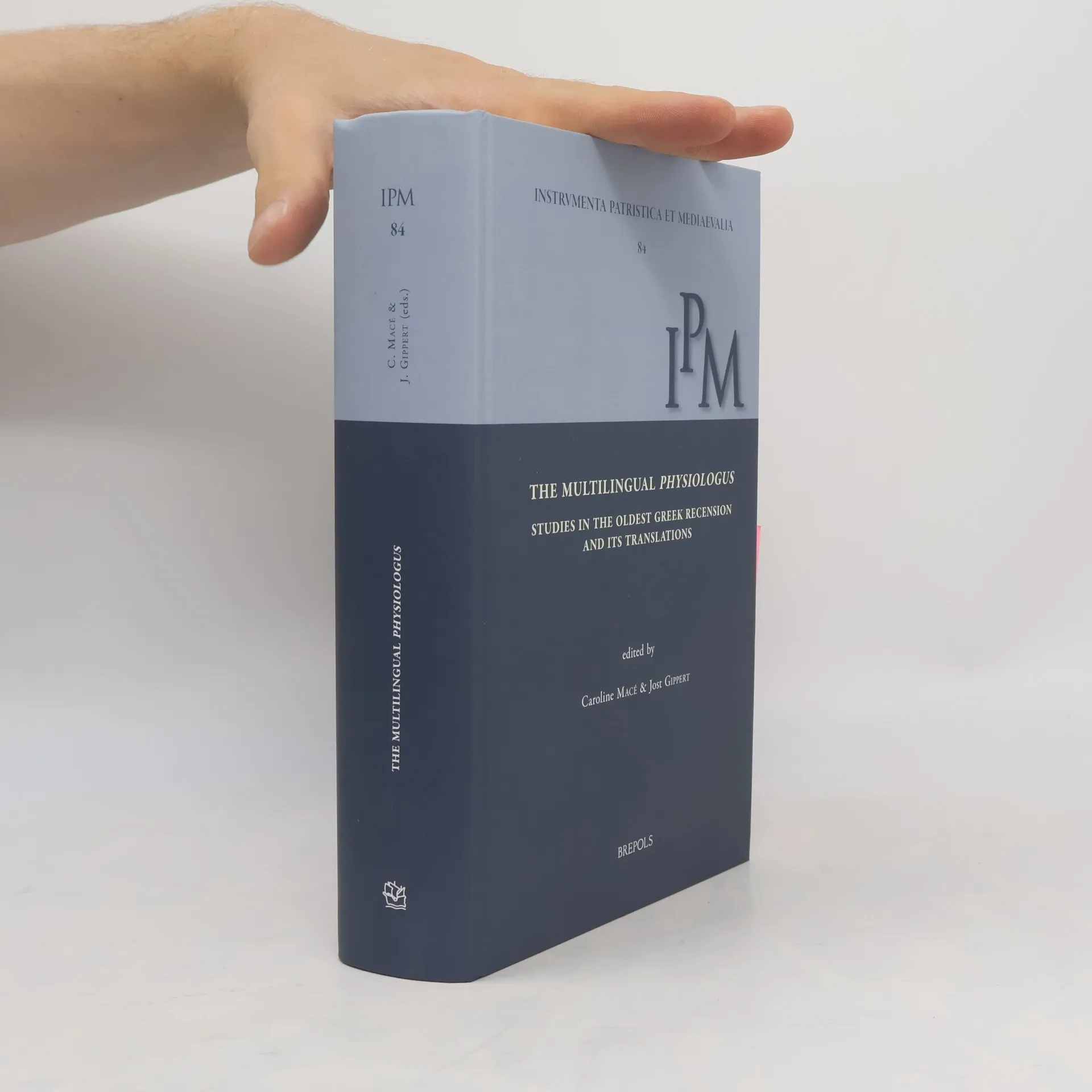
Instrumenta Patristica Et Mediaevalia - 84: The Multilingual Physiologus, Caroline Macé, Jost Gippert
- Idioma

- Publicado en
- 2021
- product-detail.submit-box.info.binding
- (Tapa dura),
- Estado del libro
- Dañado
- Precio
- 50,15 €
Métodos de pago
Nadie lo ha calificado todavía.
- Subtítulo
- Studies in the Oldest Greek Recension and Its Translations
- Idioma
- Inglés
- Autores
- Caroline Macé, Jost Gippert
- Editorial
- Brepols
- Publicado en
- 2021
- Formato
- Tapa dura
- Páginas
- 661
- ISBN10
- 250358974X
- ISBN13
- 9782503589749
- Serie
- Etiquetas
- No ficción, Historia, Temas religiosos, Historia de la iglesia, Estudios religiosos, Patrística
- Descripción
- This book uncovers new material about the ancient Christian work known as the Physiologus, providing insights into its multilingual transmission and reception. It features ten chapters and new editions of sample texts, focusing on the oldest Greek recension and its early translations into Latin, Armenian, Syriac, Coptic, Ethiopic, Georgian, Arabic, and Old Slavonic. Produced by specialists, it serves as a reference work and a model for studying ancient texts in multiple languages. The Physiologus is a collection of stories about animals, stones, and plants that serve as moral examples for Christians. Originally written in Greek, it has maintained its appeal through various adaptations. This volume includes an introduction to the Greek text's significance, a new examination of its manuscript tradition, and a revised overview of each ancient translation. Two chapters, focusing on the pelican and panther, are edited in Greek and each translation, accompanied by new English renderings and interpretative essays on the animals. The work offers fresh insights into the Physiologus's diffusion and reception from its composition in the third century CE in Alexandria to the end of the Middle Ages, spanning regions of the Byzantine Empire, the Latin West, Egypt, Ethiopia, the Middle East, the Caucasus, and Slavia orthodoxa.