



Más información sobre el libro
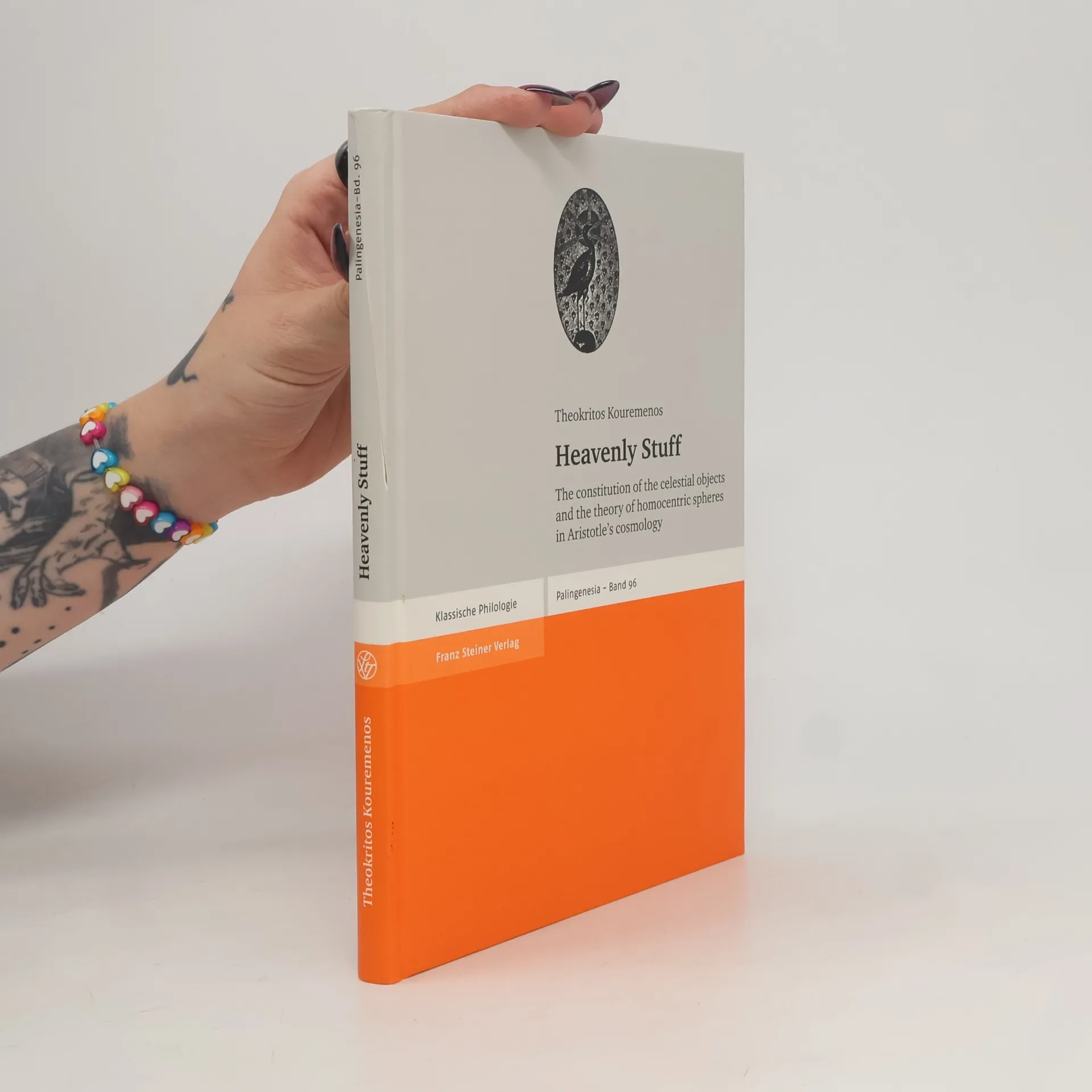
This book offers a reappraisal of basic aspects of Aristotelian cosmology. Aristotle believed that all celestial objects consist of the same substance that pervades the heavens, a stuff unlike those found near the center of the cosmos that compose us and everything in our immediate surroundings. Kouremenos argues that, contrary to the received view, Aristotle originally introduced this heavenly stuff as the matter of the stars alone, the remotest celestial objects from the Earth, and as filler of the outermost part of the heavens, forming a diurnally rotating spherical shell whose fixed parts are the stars, the crust of the cosmos which has the Earth at its center. The author also argues that, contrary to another common view, at no point in the development of his cosmological thought did Aristotle believe the heavens to be structured according to the theory of homocentric spheres developed by his older contemporary Eudoxus of Cnidus, in which the other celestial objects, the five planets known in antiquity, the Sun and the Moon, were hypothesized to move uniformly in circles, as if they were fixed stars.
Compra de libros
Palingenesia - 96: Heavenly Stuff, Theokritos Kouremenos
- Idioma

- Publicado en
- 2010
- product-detail.submit-box.info.binding
- (Tapa dura),
- Estado del libro
- Dañado
- Precio
- 33,87 €
Métodos de pago
Nadie lo ha calificado todavía.
- Subtítulo
- The Constitution of the Celestial Objects and the Theory of Homocentric Spheres in Aristotle's Cosmology
- Idioma
- Inglés
- Autores
- Theokritos Kouremenos
- Editorial
- Franz Steiner Verlag
- Publicado en
- 2010
- Formato
- Tapa dura
- Páginas
- 150
- ISBN10
- 3515097333
- ISBN13
- 9783515097338
- Serie
- Etiquetas
- Ficción, Tema histórico, Temática filosófica, Clásicos, Ciencia, Espacio, Ciencia literaria, Cosmología
- Descripción
- This book offers a reappraisal of basic aspects of Aristotelian cosmology. Aristotle believed that all celestial objects consist of the same substance that pervades the heavens, a stuff unlike those found near the center of the cosmos that compose us and everything in our immediate surroundings. Kouremenos argues that, contrary to the received view, Aristotle originally introduced this heavenly stuff as the matter of the stars alone, the remotest celestial objects from the Earth, and as filler of the outermost part of the heavens, forming a diurnally rotating spherical shell whose fixed parts are the stars, the crust of the cosmos which has the Earth at its center. The author also argues that, contrary to another common view, at no point in the development of his cosmological thought did Aristotle believe the heavens to be structured according to the theory of homocentric spheres developed by his older contemporary Eudoxus of Cnidus, in which the other celestial objects, the five planets known in antiquity, the Sun and the Moon, were hypothesized to move uniformly in circles, as if they were fixed stars.