

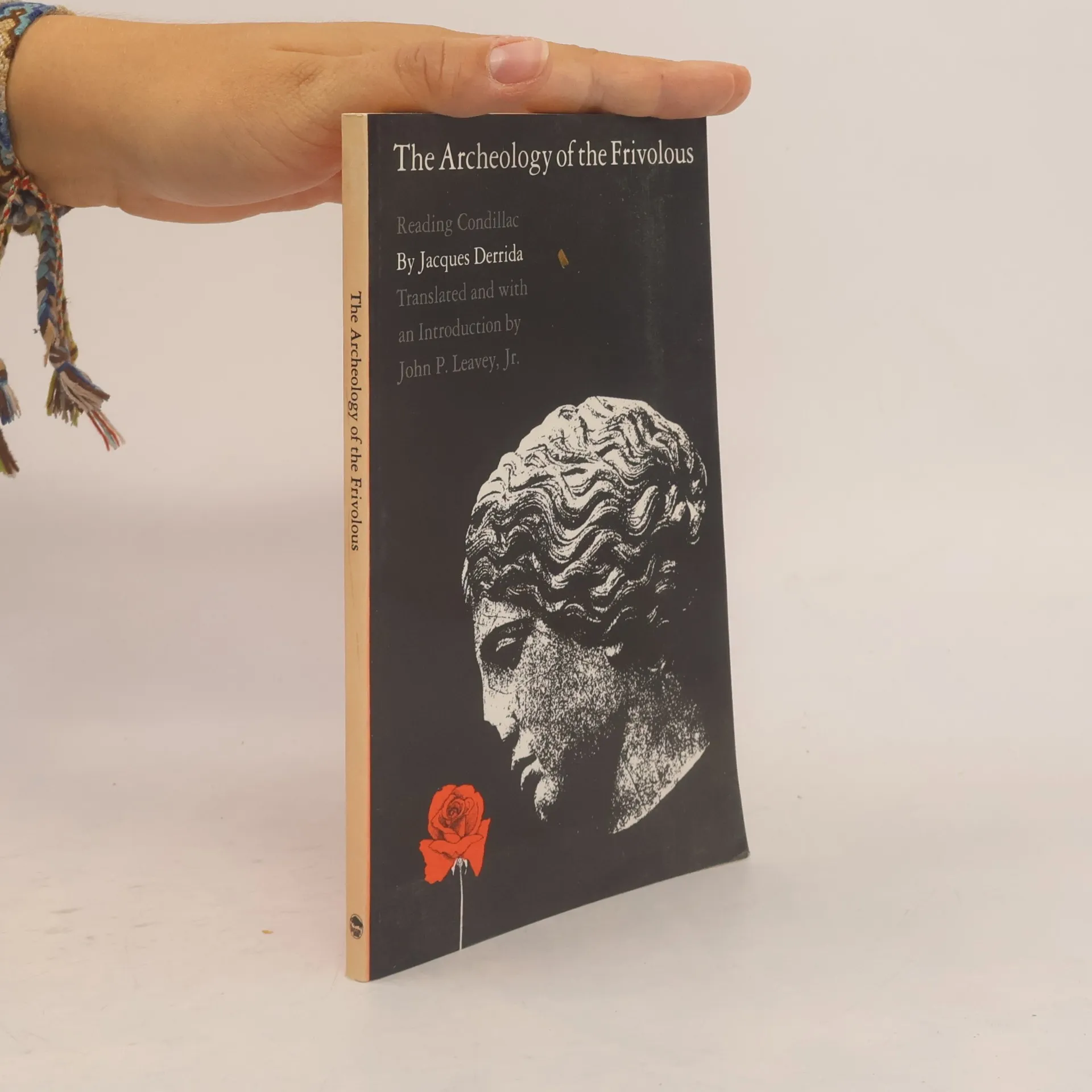
Más información sobre el libro
In 1746 the French philosophe Condillac published his Essay on the Origin of Human Knowledge , one of many attempts during the century to determine how we organize and validate ideas as knowledge. In investigating language, especially written language, he found not only the seriousness he sought but also a great deal of frivolity whose relation to the sober business of philosophy had to be addressed somehow. If the mind truly reflects the world, and language reflects the mind, why is there so much error and nonsense? Whence the distortions? How can they be remedied?In The Archeology of the Frivolous , Jacques Derrida recoups Condillac's enterprise, showing how it anticipated--consciously or not--many of the issues that have since stymied epistemology and linguistic philosophy. If anyone doubts that deconstruction can be a powerful analytic method, try this.

Compra de libros
The Archeology of the Frivolous, Jacques Derrida, John P. Leavey, Jr.
- Idioma

- Publicado en
- 1987
- Encuadernación
- (Tapa blanda)
Métodos de pago
Nadie lo ha calificado todavía.
- Título
- The Archeology of the Frivolous
- Subtítulo
- Reading Condillac
- Idioma
- Inglés
- Autores
- Jacques Derrida, John P. Leavey, Jr.
- Editorial
- University of Nebraska Press
- Publicado en
- 1987
- Formato
- Tapa blanda
- Páginas
- 143
- ISBN10
- 0803265719
- ISBN13
- 9780803265714
- Serie
- Categorías
- Etiquetas
- Temática filosófica, Teorías científicas
- Descripción
- In 1746 the French philosophe Condillac published his Essay on the Origin of Human Knowledge , one of many attempts during the century to determine how we organize and validate ideas as knowledge. In investigating language, especially written language, he found not only the seriousness he sought but also a great deal of frivolity whose relation to the sober business of philosophy had to be addressed somehow. If the mind truly reflects the world, and language reflects the mind, why is there so much error and nonsense? Whence the distortions? How can they be remedied?In The Archeology of the Frivolous , Jacques Derrida recoups Condillac's enterprise, showing how it anticipated--consciously or not--many of the issues that have since stymied epistemology and linguistic philosophy. If anyone doubts that deconstruction can be a powerful analytic method, try this.